




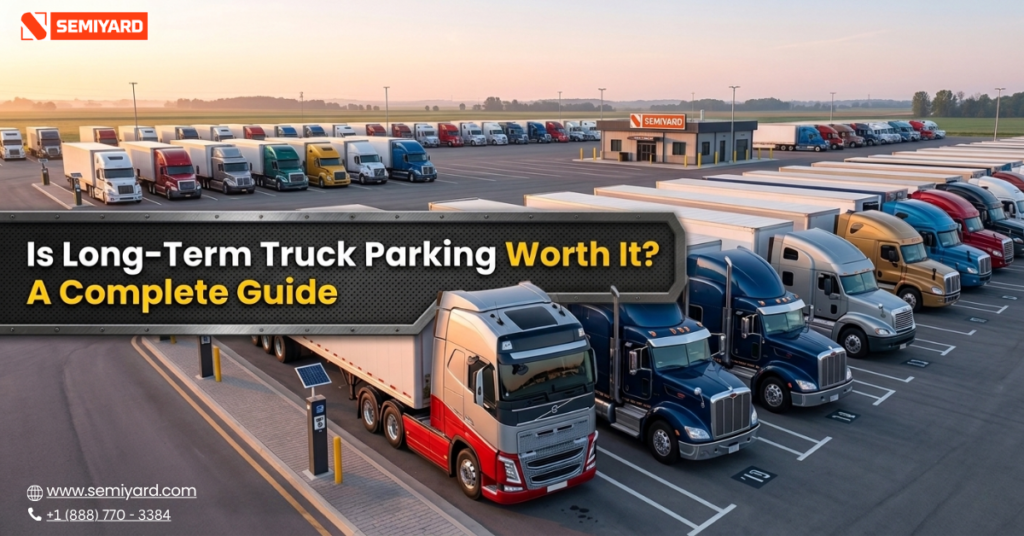
No one can deny the fact that trucking isn’t a 9-to-5 job. The life of a truck driver is one with inconsistent hours, changing paths, and every day searching for parking spaces beyond the map. In such a lifestyle, long-term truck parking is an inevitable solution for a business model to follow. Every trucker wishes to have a constant place to park following a hectic drive day!
This blog explains it all for you: what long-term parking is and how come this will play a big role in changing the future of trucking. Keep reading to find out more and say goodbye to the late-night search troubles!
Table of Contents
ToggleKey Takeaways
- Long-term truck parking provides a stable, monthly-billed solution that ends the stressful nightly search for vacant spots.
- Prefer lots near major highways and distribution centers to significantly reduce fuel consumption and vehicle wear-and-tear.
- Essential 24/7 accessibility allows drivers to strictly adhere to HOS regulations regardless of unpredictable delivery schedules.
- Modern tech integrations and real-time apps now enable truckers to verify space availability and book spots digitally before they arrive.
- Both individual owner-operators and fleet managers benefit from predictable fixed costs and enhanced security for their equipment between loads.
- Ultimately, moving to a long-term parking model transforms a chaotic daily hurdle into a streamlined business asset for trucking.
What Is Long-Term Truck Parking?
The parking lots for commercial vehicles give truckers practical ways to balance their runs across the USA for months at a time. The long-term lots come with a monthly truck parking cost and are made just for the size, weight, and needs of semi-trucks and 18-wheelers, not for pull-outs at rest stops or weigh stations.
These kinds of services are usually close to major highways, freight corridors, distribution centers, and other trucking services. Since they bill by the month, which means that both owner-operators and fleet managers can expect the same rates every month. Most of them are open 24 hours a day and have lights for smooth operations at night, such as Semiyard Truck Parking. Long-term parking fills a real need in the trucking industry for drivers who need a place for truck storage parking between loads.
The Economic Impact of Poor Parking
Just ask any trucker, and you’ll know that the difficulty of finding a verified place to park is possibly one of the most stressful aspects of trucking. There is danger in parking on unknown and open unverified areas. Pushing past a rest area incurs extra distance and consumes fuel. The rest window is eaten into by circling a truck stop for 45 minutes at midnight, where an eagerness to park leads in practice to increased fatigue. You may get hundreds of miles behind you, but if your life tumbles into a resting place jammed in between two other trucks with your mirrors inches from someone else’s bumper—which is not adequate parking—that is stress on wheels.
The costs quickly mount up: fuel idling, fines for stopping illegally by the side of the road, wear-and-tear from excess driving, and the real toll on driver health and mental well-being.
It won’t be wrong to say that there is a huge parking duration comparison between daily and monthly parkings. Long-term parking solves much of this chaos by providing drivers a constant place to be where they are supposed to be, no hunting required.
Why 24/7 Availability Is Non-Negotiable
You can punch the clock, but as trucking follows, you never really clock out. As freight moves, deliveries can occur any day of the week, and mechanical problems do not keep bank hours. That is precisely why the availability of truck parking 24/7 is not a premium amenity but rather an absolute necessity, with fleet parking benefits.
An ideal parking lot must have round-the-clock accessibility so truckers can get in when it suits their schedule. Whether they are finishing a night run at 4 AM or need to drop a trailer on a federal holiday, with 24/7 gates unlocked. Such accessibility correlates directly with Hours of Service rule adherence: drivers will never have to push themselves or their equipment beyond legal (or personal) limits to arrive at a facility ahead of closing hours.
That simplicity provides various fleet parking benefits, where several trucks run on staggered schedules. Easily available and close to major routes, parking space simplifies logistics planning since you know exactly where a unit will be parked between dispatches, thence optimizing your entire route planning process.
The Future with Technology-Enabled Truck Parking
Over the past several years, the largest change in long-term truck parking hasn’t just taken place at the lots; it’s majorly been how drivers locate and utilize them. The technology is advancing, so the gap between the truckers and perfect parking places is slowly bridging.
Transport and logistics professionals can conveniently use a single universal GPS-integrated parking app to find nearby long-term truck parking on the go in real time with available lots filtered by amenities, price, distance from the highway, and facility type. A driver can access live availability data before they’ve even reached the yard. This is incredibly important in high-density corridors; understanding that a lot has three vacant spots left vs. being at capacity can save a driver 30 minutes of detours and frustration.
The booking and payment systems are also digital. Fewer do’s, with no paperwork, as well as extra time driving! If you are a fleet operator with dozens of units, you can use centralized dashboards to monitor parking locations, cost, and availability across an entire fleet on one screen.
Long-Term Parking for Owner-operators & Fleet Managers
Someone in trucking might keep wondering, ” Is truck parking worth it, given the chaos while finding an ideal one? However, you must understand the long-term parking value proposition is different.
For individual truckers and owner-operators, long-term parking is often about stability and cost control. A flat monthly parking fee for a reserved space near major freight corridors or service points is far more predictable than the nightly scramble for free roadside accommodation. It also serves as a kind of professional address to the business, which makes it kind of relevant when booking pickups, drops, and repairs.
Long-term parking is a tool fleet managers can use to improve the efficiency of their operations. Law enforcement agencies lower their exposure to liability and insurance by keeping inactive units in a monitored facility, yet they can still rapidly reactivate vehicles. The truck is also where it needs to be. And when a new contract comes in, or a driver becomes available, fueled up, and ready to roll.
Both groups gain predictability from long-term agreements. Almost everything in the industry is variable—rates, routes, fuel prices, weather—and a fixed parking spot is a near-constant.
Finding Right Platform for Long Term Truck Parking
Prior to finalizing a long-term truck parking lot, consider the following services for the added comfort of truckers:
- Location proximity to freight corridors, such as distance to interstates, freeways, and major service centers, to minimize deadhead miles
- Access around the clock to align with the drivers on shifting schedules
- Security features like perimeter fencing, cameras, and lighting at night
- Space dimension check if the lot fits well according to your truck size, particularly for oversized trucks
- Amenities like dumpsters, restrooms, nearby gas stations, and food availability to provide truckers with comforts during long dwell times
- Transparent monthly truck parking plans that come without fees or surprise surcharges
- Live availability data that provides real-time statuses.
Truck parking platforms, such as Semiyard, show live space availability so that as a driver, you can visualize exactly what is available and where and at what cost. That sort of real-time visibility is very valuable to a person who has to balance tight delivery deadlines with legally mandated park time.
Whether you are an owner-operator in need of a steady monthly parking base or a fleet operator seeking to keep vehicles organized between dispatches, a well-kept parking platform alleviates much of the trouble that complicates trucking.
Conclusion
In a nutshell, long-term truck parking is the best solution for the truck drivers, owner operators, and fleet managers alike. It reduces last-moment parking stress, promotes regulatory compliance, and brings predictability to a constantly evolving trucking profession. Especially when that solution includes 24/7 access and technology to provide real-time availability across your key corridors. Then it’s less about “How much is this worth?” and more about “Why did I not opt for long-term monthly parking earlier?”
The road is unpredictable enough. Your parking should not be.
FAQs
What is long-term truck parking?
Long-term truck parking is a monthly parking solution for semi-trucks and other commercial vehicles that provides a fixed parking space where drivers can park for months. These lots, such as those by Semiyard, are built for large trucks and are usually located near highways, freight hubs, and distribution centers.
Why do truck drivers need long-term parking?
Truck drivers work irregular hours and often struggle to find parking. Long-term parking gives them a constant place to park after long drives. It saves time, reduces stress, and helps drivers avoid unsafe roadside parking.
How does poor truck parking affect costs?
Poor parking can increase fuel costs, fines, and vehicle wear and tear. Drivers may waste time searching for spots or drive extra miles. It also affects health due to stress and fatigue, which can impact overall productivity and safety.
Why is 24/7 truck parking important?
Trucking runs all day and night, so parking must be available anytime. 24/7 access allows drivers to park when needed without breaking hours of service rules. It also helps fleet managers plan routes better and avoid delays.
How does technology improve truck parking?
Modern truck parking platforms, such as the Semiyard app, use GPS and real-time data to show available spots. Drivers can find, book, and pay for parking easily using apps. This reduces guesswork, saves time, and improves route planning.
Is long-term truck parking worth it for owner-operators and fleets?
Yes, it offers stable monthly pricing and an assured parking spot. Owner-operators get cost control, while fleet managers improve organization and reduce risks. It also ensures trucks are ready for the next job.
What should you look for in a truck parking platform?
Choose a platform with good location access, 24/7 availability, and proper space for your truck. Look for clear pricing, useful amenities, and real-time availability updates to make parking easier and smoother.