




Reviewed by the Semiyard Vendor Success Team — we work directly with repair shops and mobile mechanics listing on Semiyard’s nationwide truck parking and service marketplace.
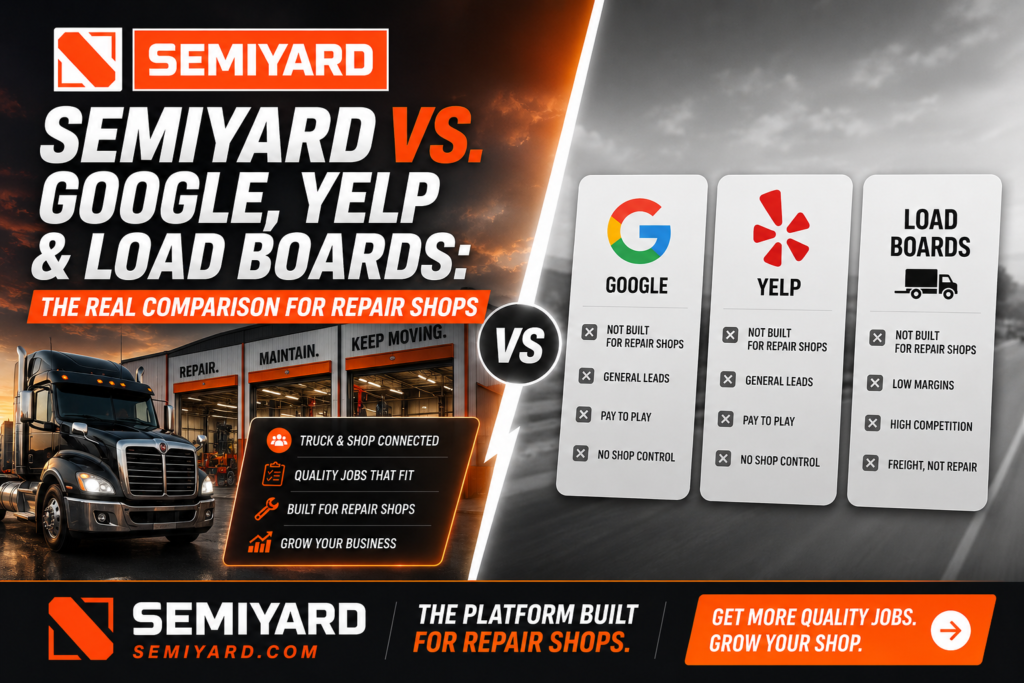
If you run a truck repair shop or work as a mobile mechanic, you’ve likely been pitched more than one platform promising to help truckers find you. Some are general local-business directories. Some are freight or load-matching apps with a repair tab bolted on. Some simply sell you leads by the phone call.
Before you spend time or budget on any truck service marketplace, it’s worth asking one question: will this platform put your business in front of the right driver, at the right moment, with enough information to turn a search into a booked job?
This guide compares the main options — general directories, load boards, and pay-per-lead services — against Semiyard, a marketplace built specifically for truck parking, repair shops and mobile mechanics across the U.S.
Table of Contents
ToggleQuick Comparison: Truck Service Marketplace Options
| Platform Type | Built For | Repair-Specific Details | Best For |
|---|---|---|---|
| General directories (Google, Yelp) | All local businesses | Minimal — name, hours, reviews | Basic visibility, not urgent searches |
| Load boards / freight apps | Dispatchers & brokers | Repair listings are a secondary feature | Freight-adjacent exposure only |
| Pay-per-lead services | Lead volume | No service-matching filters | Shops with room for wasted calls |
| Semiyard | Truckers & fleet managers needing repair or parking | Full service menus, certifications, bay availability, coverage area | Shops and mobile mechanics wanting qualified, ready-to-book drivers |
General Directories: Broad Reach, Limited Context
Google Business Profiles and Yelp are built for restaurants, retail, and general local services — not the specific, urgent needs of a trucker with a broken-down rig. A driver searching for help typically needs to know:
- Can this shop handle my specific issue (engine, brakes, reefer unit)?
- Are they certified for my truck’s make and system?
- How fast can they turn the truck around?
General directories don’t have structured fields to answer these questions — your listing looks the same as a nail salon down the street.
On Semiyard, your profile is built around service menus, certifications, bay availability, and turnaround times, so a driver can confirm you’re the right shop before they ever call.
Load Boards and Freight Apps: Repair as an Afterthought
Some freight-matching platforms added a repair or roadside directory as a secondary feature. These apps are optimized for dispatchers and brokers moving loads — not for a driver stranded on the shoulder searching “diesel mechanic near me” in real time. Repair listings on these platforms are often thin and rarely updated.
Semiyard is built around the repair and parking moment itself — breakdowns, scheduled maintenance, DOT inspections — so listings aren’t a secondary feature. They’re the core of the platform.
Pay-Per-Lead Services: Volume Over Fit
Some services sell you leads directly: your phone rings, you pay, whether or not the job is a fit. This model rewards volume, not accuracy — you often pay for calls from drivers outside your service area or needing repairs you don’t offer.
On Semiyard, specific service categories (trailer refrigeration service, mobile tire replacement, DOT inspections) and defined coverage areas mean drivers self-select into shops that can actually help, so the calls you receive are already closer to a fit.
What Sets Semiyard Apart
- Built for trucking, not general local search. Drivers and fleet managers searching for repair help are the core audience, not an add-on category.
- Structured profiles, not static listings. Certifications, bay availability, turnaround times, and coverage area are searchable fields — not buried in a paragraph.
- Shops and mobile mechanics in one marketplace, so your business shows up whether a driver searches for a fixed location or a mechanic who comes to them.
- Reviews build in one place, compounding into consistent lead flow instead of scattering across platforms that weren’t designed for trucking.
- A direct line from search to booking, connecting drivers and fleet managers to verified providers without the noise of an unrelated freight or local-business platform.
Frequently Asked Questions
What makes Semiyard different from Google or Yelp for truck repair shops? Semiyard profiles include trucking-specific details — service menus, certifications, bay availability, and turnaround times — that general directories aren’t built to show.
Is Semiyard only for repair shops, or does it work for mobile mechanics too? Both. Mobile mechanics can list a coverage area so they show up in searches from drivers within reach, alongside fixed-location shop listings.
Do I pay per lead on Semiyard? Semiyard listings are built around a complete business profile rather than a pay-per-call model, so you’re not charged simply for a phone ringing. Check the information on the vendor page.
How do I get started listing my repair or mobile service business? Create a business profile, define your specific services, add certifications and experience, upload photos, and start collecting reviews. Full steps are available on the vendor page.
The Bottom Line
General directories, load boards, and pay-per-lead services aren’t necessarily bad — a Google listing is still worth having. But none of them were built around the specific problem of matching a stranded or scheduling driver with the right repair provider, fast. That’s the gap Semiyard fills.
If you’re deciding where to invest your limited marketing time, the question isn’t which platform has the most users — it’s which platform puts your shop in front of a driver who’s actually searching for exactly what you offer, with enough detail to convert that search into a booked job.
See how your shop or mobile service shows up to drivers searching right now. List your business on Semiyard and start getting found by the traffic already looking for you.