


The receiver signs the bills, the trailer is empty, and the truck is sitting in a city you may not know well. Every hour spent figuring out the next load is an hour the truck isn’t earning. For a lot of carriers, that search still means calling brokers, texting contacts, and flipping between apps to compare lanes.
A free truck load board is one way to shorten that search. It puts available freight in one place where carriers can search by lane, equipment, and date, and where brokers can post loads that need a truck. It won’t find the perfect load for you, but it gives you more options to evaluate before you commit your equipment and your hours.
This guide explains how a load board for trucks works, how carriers, owner-operators, dispatchers, and brokers use one, and what to check before you accept any load. It also covers how the Semiyard Load Board fits into that picture alongside Semiyard’s truck parking and trucking services marketplace.
Table of Contents
ToggleWhat Is a Truck Load Board?
A truck load board is an online marketplace where freight that needs to move is posted and carriers with available trucks search for it. Some boards also let carriers post their trucks, so brokers can search for capacity instead of waiting for calls.
The main users are freight brokers and shippers on one side, and motor carriers, owner-operators, fleet managers, and dispatchers on the other. Each posting is a snapshot of one shipment. A typical listing shows origin and destination, pickup and delivery dates, equipment type, weight, and often a rate or a request to call for one. Better postings add the commodity, trailer length, special handling, and appointment details.
The basic relationship looks like this:
Broker posts load → Carrier searches → Carrier reviews details → Carrier and broker communicate → Both parties agree on the load
That last step matters. On many boards, the listing is where the conversation starts, not where the deal is finished. Rate negotiation, carrier setup paperwork, and the rate confirmation may happen by phone, email, in-app messaging, or a mix of all three, depending on the platform and the broker.
What Is a Free Truck Load Board?
A free truck load board lets users search for or post freight without paying a subscription fee. That’s the core idea, but “free” covers a lot of different business models, so it pays to read the fine print.
Some boards are free because a broker runs them to cover its own freight. Others are free for carriers but charge brokers to post. Some offer a free tier with a paid upgrade for extras like rate history, credit data, or alerts. And some bundle load board access with another service. The question isn’t just “is it free?” but “what exactly is free, and for whom?”
Why carriers look for free load boards. Owner-operators and new authorities often watch every fixed cost. A no-cost board lets them look for freight without adding another monthly bill, and it can be used alongside other sources rather than instead of them.
Why brokers post on them. Every board reaches a slightly different pool of carriers. Posting on an additional board can put a load in front of trucks a broker might not otherwise reach.
Free doesn’t automatically mean better or worse. Load volume, lane coverage, listing quality, and the tools you get all vary by provider. Judge a free board on whether it shows freight that fits your equipment and lanes.
How Does a Load Board for Trucks Work?
Most load boards follow the same basic flow, even if the screens look different. Here’s how it works from both sides.
Step 1: Search or post
Carriers and dispatchers search available loads. Brokers post freight that needs a truck, with as much shipment detail as they have.
Step 2: Enter the lane
A search usually starts with origin and destination. You can often set a radius around each point, so a search from Dallas might also catch loads picking up in Fort Worth or Denton. Add pickup and delivery dates to filter out freight that doesn’t fit your schedule. Leaving the destination open is useful when you care more about getting loaded than where you end up.
Step 3: Select equipment
Filter by what you actually run: dry van, reefer, flatbed, step deck, box truck, hotshot, or other types where the board supports them. A 53-foot dry van load won’t work for a 26-foot box truck, and a reefer load with a set temperature requirement won’t work in a dry van.
Step 4: Review load details
Open the listing and read all of it. Check the commodity, weight, total miles, pickup and delivery locations and windows, the rate (if posted), and any equipment requirements like straps, tarps, load locks, or team drivers.
Step 5: Evaluate the opportunity
A load that looks good on the list can look very different once you do the math. Factor in deadhead to the shipper, fuel, tolls, available driving hours, appointment times, and where the delivery leaves you for the next load. Look at total operating cost, not just the posted number.
Step 6: Contact the relevant party
If the load still makes sense, reach out to the broker or poster through whatever channel the board provides. Confirm the details, ask what’s missing, and negotiate the rate if needed. Nothing is booked until both sides agree and the terms are confirmed in writing, typically in a rate confirmation.
How Carriers Can Use a Free Truck Load Board
For a motor carrier, a load board works best as a planning tool rather than a last-minute scramble. Used well, it can help carriers identify potential freight that may fit their route.
Finding the next load. Search from where the truck will empty, not where it is right now. If a delivery in Memphis wraps up tomorrow afternoon, search for Memphis-area pickups on tomorrow’s date while the truck is still rolling.
Finding backhauls. A backhaul is a load that moves your truck back toward home or toward a stronger freight market after a delivery. Carriers that run regional or dedicated outbound freight often use a load board specifically to fill the return trip.
Cutting down empty miles. Deadhead is the distance you drive empty, whether that’s from the receiver to the next shipper or back to your yard. Every deadhead mile burns fuel and time with no revenue attached. A board won’t eliminate empty miles, but comparing pickups by distance from your drop point helps you keep them in check.
Comparing freight side by side. Seeing several loads out of the same area makes it easier to weigh one against another. A lower-paying load that picks up two miles away and delivers into a busy market may beat a higher-paying one with 150 miles of deadhead and a weak destination.
Matching the equipment. Filtering by trailer type and weight keeps you from wasting calls on freight you can’t legally or physically haul.
How Owner-Operators Can Find Loads
Owner-operators usually don’t have a dispatch team sourcing freight for them, so the way you search matters. A few habits make a load board for owner-operators far more useful.
- Search from your empty point. Use the city where you’ll deliver, not your current location, if you’re planning ahead.
- Set a sensible radius. Start around 50 miles and widen it only if nothing fits. A wider net finds more loads but also more deadhead.
- Filter by your exact equipment. Trailer type, length, and weight capacity all count.
- Line up pickup dates with your clock. Under FMCSA hours-of-service rules, property-carrying drivers can drive up to 11 hours after 10 consecutive hours off duty, can’t drive past the 14th hour after coming on duty, and need a 30-minute break after 8 cumulative hours of driving. A load you can’t legally reach on time isn’t a real option.
- Compare destinations, not just rates. Ask where the load leaves you and how easy it will be to get out of there.
- Calculate deadhead before you call. Add empty miles to loaded miles, then look at the rate across the total.
- Read the full posting. Commodity, weight, and appointment details can change the whole picture.
- Line up two or three options. Having alternatives gives you a better sense of what’s reasonable for the lane.
A practical example
An owner-operator running a dry van delivers in Atlanta on Thursday morning and wants to be home in Charlotte by the weekend. Instead of waiting until the trailer is empty, the driver searches Wednesday night for Atlanta-area pickups on Thursday afternoon, with Charlotte as the destination and a 50-mile radius on both ends.
Three loads come up. One pays the most but picks up 90 miles south of Atlanta, which adds deadhead and pushes the pickup time close to the end of the driver’s 14-hour window. Another picks up 15 miles from the receiver but delivers Monday, which means a weekend on the road. The third picks up 30 miles away, delivers Friday near Charlotte, and has a posted appointment that fits the driver’s available hours.
The third load may not have the highest posted rate, but after deadhead, fuel, and the driver’s schedule are factored in, it’s likely the best fit. That’s the kind of judgment a load board supports, not replaces.
How Freight Brokers Can Use a Load Board
For a freight broker, a load board is a way to put a shipment in front of carriers who have the right truck in the right area. The quality of the posting has a lot to do with the quality of the responses.
A strong posting includes:
- Origin and destination, with city, state, and ZIP where possible
- Pickup and delivery windows, plus whether appointments are firm or FCFS
- Equipment requirements, including trailer type, length, and any securement, temperature, or team needs
- Weight, commodity, and dimensions, especially for flatbed or oversize freight
- Rate information, where the broker chooses to share it
- Special handling, such as hazmat, driver assist, lumper arrangements, or TWIC requirements
Complete postings save time on both ends. A carrier who can see the whole picture up front calls only if the load genuinely fits, and the broker spends less time answering the same questions.
Posting a load doesn’t shift any responsibility onto the platform. Under federal law, a broker must be registered with FMCSA to arrange interstate freight, and brokers are required to keep records of each transaction under 49 CFR 371.3. Brokers remain responsible for vetting the carriers they work with, including confirming active operating authority and insurance. FMCSA’s SAFER system lets anyone look up a company’s registration details, and it’s good practice to verify contact information against those records rather than relying on what’s provided during the call.
How Semiyard’s Free Truck Load Board Works
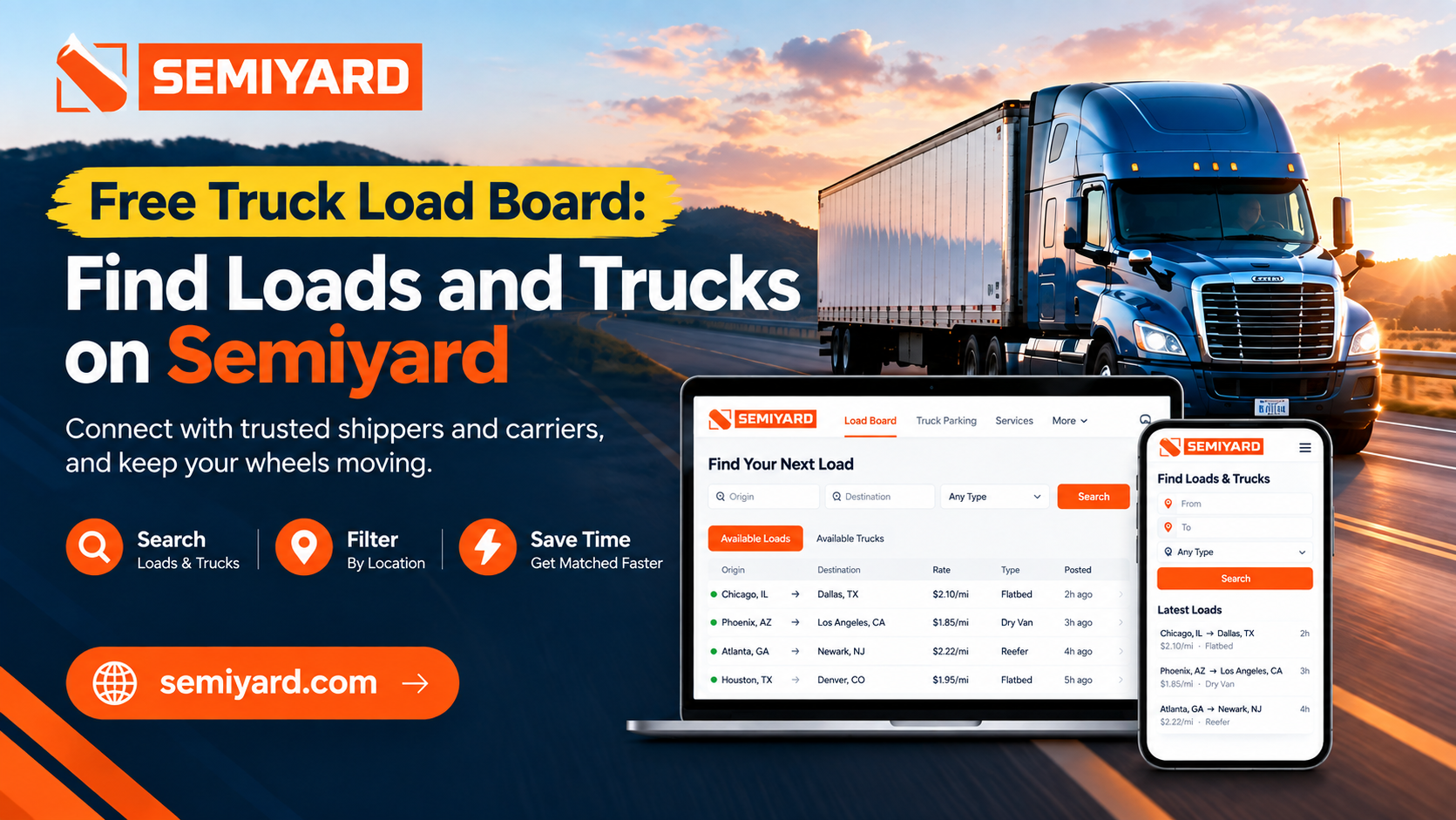
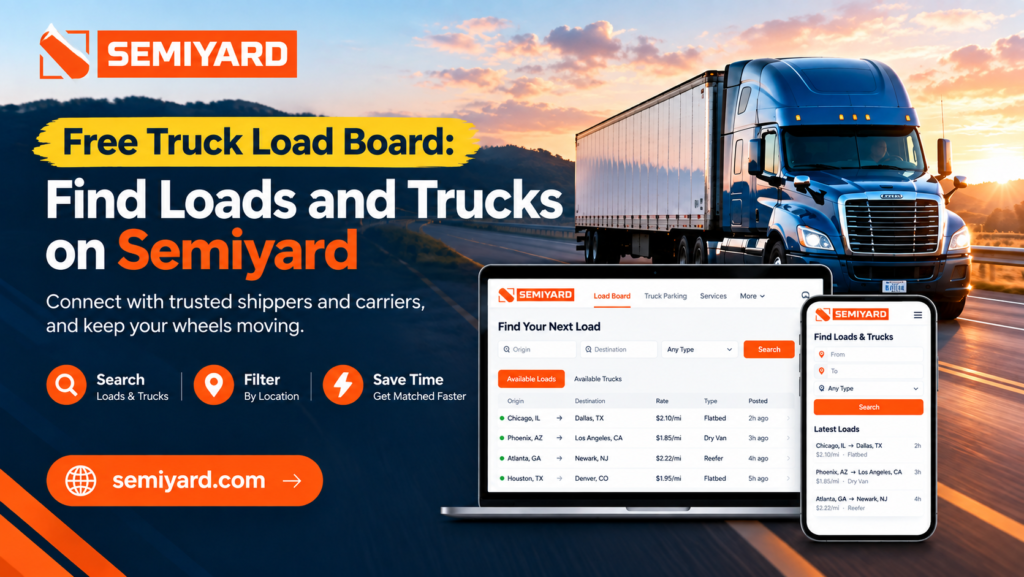
Semiyard is a technology platform for the trucking industry, best known for helping drivers and fleets find monthly truck parking. Its load board extends that platform to freight, connecting freight brokers, available loads, carriers, and trucks in one marketplace.
Freight brokers ↔ Available loads ↔ Carriers ↔ Trucks
Semiyard describes the load board as a single place where carriers and brokers work from the same real-time listings instead of juggling separate tools, group chats, and spreadsheets.
For carriers and owner-operators, Semiyard says the board lets you search posted loads and filter them by origin, destination, equipment type, rate, and pickup date, so you see freight that matches your lanes and trailer. Semiyard also describes in-app messaging with brokers to discuss and book loads without switching apps.
For brokers, Semiyard’s materials describe creating a posting with origin, destination, equipment type, weight, dimensions, pickup window, and rate, then reviewing carrier responses as they come in.
Semiyard’s role is to host the listings and make the connection. It isn’t a freight broker, carrier, or dispatcher, and it doesn’t guarantee that any particular load will be available, suitable, or profitable. Which loads appear, what rates are agreed, and whether a shipment is completed depend on the brokers and carriers using the platform. Carriers should still vet the brokers they work with, and brokers should still vet their carriers.
Why Use Semiyard’s Free Load Board for Trucks?
The practical case for Semiyard comes down to cost, the people on the platform, and what else lives in the same app.
Free access
Semiyard presents its load board as free to use for finding loads. Access terms can change and may be tied to account type or other Semiyard services, so check the current details on the Semiyard Load Board page when you sign up.
Carrier and broker connections
The board is designed to bring both sides of a load into the same marketplace. Carriers searching for freight and brokers looking for capacity see the same listings, which cuts down on calls about loads that are already covered or don’t fit.
Load discovery
Searching by lane, equipment, rate, and pickup date narrows the list to freight you can actually consider. That’s the core job of any load board, and it’s where most of your time on the platform should go.
A broader transportation platform
Semiyard also runs a truck parking marketplace, a directory of trucking services such as repair shops and mobile mechanics, and a way for landowners to list property for truck parking. The company also offers an AI-Driven TMS, a transportation management system meant to help carriers and fleets organize day-to-day operations such as loads and related records. Specific TMS capabilities should be confirmed on Semiyard’s TMS page, since features vary and evolve.
What Should You Check Before Accepting a Truck Load?
Finding a load is the easy part. Deciding whether it makes operational and financial sense is where carriers protect their margins. Run every load through a checklist like this before you commit.
- Pickup location and how far it is from your empty point
- Delivery location and the freight market it leaves you in
- Pickup date and time, including whether it’s an appointment or first-come, first-served
- Delivery date and time
- Equipment required, including length, securement, temperature settings, or team drivers
- Commodity, and whether it needs special handling, permits, or endorsements
- Weight, checked against your truck’s legal and practical limits
- Loaded miles
- Deadhead miles to the shipper
- Rate, and what it works out to across loaded plus deadhead miles
- Fuel costs for the full trip
- Tolls on the likely route
- Loading and unloading requirements, such as driver assist, lumpers, or live vs. drop
- Appointment requirements at both ends
- Detention terms: when the clock starts and what’s paid
- Broker information, including active authority and matching contact details in FMCSA records
- Payment terms, including timing and any quick-pay fees
- Driver hours and route feasibility under hours-of-service limits
The highest posted rate isn’t always the best fit. A load with long detention, a tight appointment, heavy deadhead, or a destination with little outbound freight can cost more than it pays. Get the key terms in the rate confirmation before you dispatch.
Free Load Board vs Paid Load Board
Neither type is automatically better. The right choice depends on your lanes, equipment, budget, and which tools you actually use. Many carriers use more than one.
|
Factor |
Free load board |
Paid load board |
|---|---|---|
|
Access cost |
No subscription cost where offered |
Subscription or usage fee |
|
Load search |
Depends on platform |
Depends on platform |
|
Search filters |
Varies |
Varies |
|
Load posting |
Depends on platform |
Depends on platform |
|
Advanced tools (rate history, credit data, alerts) |
May vary; sometimes offered as paid upgrades |
May include additional features |
|
Best use |
Users seeking no-cost access to freight |
Users who need specific additional tools |
Features change often and vary widely by provider, so compare current plans directly. The useful test is simple: does the board regularly show freight that fits your equipment and lanes, with enough detail to make a decision?
Tips for Getting More Value From a Truck Load Board
- Keep your location current. Search from where the truck will empty, and update it as plans change.
- Use a reasonable radius. Too tight and you miss nearby freight; too wide and you pile on deadhead.
- Match your equipment exactly. Trailer type, length, and weight limits should be set before you search.
- Check pickup and delivery windows. Make sure they fit your available hours and any other commitments.
- Calculate deadhead. Add empty miles to the trip before judging the rate.
- Think about the whole route. Consider tolls, fuel, parking along the way, and where the load leaves you.
- Review broker and load details. Confirm authority and contact information before you commit.
- Compare several opportunities. A few options in the same area give you a better read on the lane.
- Don’t book on headline rate alone. Detention risk, appointments, and deadhead can erase a high number.
- Keep documentation organized. Rate confirmations, BOLs, PODs, and detention records make billing and disputes much easier.
Free Truck Load Board + Truck Parking: How Semiyard Connects Both Needs
Running a trucking business involves more than booking freight. Between loads, the truck and trailer need somewhere to sit. Equipment needs service. Small fleets often need a yard for trailers or extra vehicles. These needs usually get handled in separate places with separate logins.
Semiyard’s approach is to bring several of them onto one platform. Alongside the load board, drivers and fleets can find truck parking, including monthly parking for trucks and trailers, use the Semiyard truck parking app, and look up trucking services like repair and maintenance providers. Property owners can list their lots for truck parking.
The connection is practical. If you’re planning where your next load will leave you, it helps to know where you can park near your home base or along your regular lanes. Using the load board doesn’t automatically come with parking, and parking is booked separately. But having both in one place can make planning the week simpler.
Who Can Benefit From a Free Truck Load Board?
Owner-operators
Without a dispatcher, the driver is also the load planner. A free board offers a no-cost way to look for the next load or a backhaul between deliveries.
Small carriers
Carriers with a handful of trucks often rely on a few broker relationships. A load board adds more options when regular freight is slow or when a truck ends up out of its usual lanes.
Fleets
Larger fleets may have contract freight, but trucks still end up in the wrong place. A board can help fill gaps and reposition equipment with a paying load instead of an empty move.
Dispatchers
Dispatch services and in-house dispatchers search on behalf of several trucks at once. Filtering by equipment and location makes it faster to match each truck with loads worth calling on.
Freight brokers
Brokers use boards to reach carrier capacity beyond their existing network, especially on lanes where they don’t have regular trucks.
Transportation businesses
Companies that move their own freight occasionally, or that manage mixed operations, can use a board to see what’s moving in a market and to find capacity when needed.
Frequently Asked Questions
What is a free truck load board?
It’s an online marketplace where brokers post available freight and carriers search for loads without paying a subscription. Listings typically show origin, destination, dates, equipment, weight, and sometimes a rate.
Is a free load board really free?
Often the basic search is free, but the model varies. Some boards charge brokers to post, offer paid upgrades, or tie free access to another service. Check what’s included before you rely on one.
How do I find truck loads without paying for a load board?
Use free load boards, build direct relationships with brokers and shippers, and ask brokers you’ve worked with about repeat lanes. Combining several sources usually gives you more options than any single one.
Can owner-operators use a free truck load board?
Yes. Owner-operators with active operating authority can generally search and book freight on free boards, though individual brokers set their own carrier requirements, such as minimum insurance or time in business.
Can freight brokers post loads on a free load board?
Many boards allow broker posting, sometimes free and sometimes for a fee. Brokers must be registered with FMCSA to arrange interstate freight.
What information should I check before accepting a load?
Check pickup and delivery details, equipment, commodity, weight, miles, deadhead, rate, fuel, tolls, appointments, detention terms, broker information, payment terms, and whether the trip fits your available hours.
How does a load board help carriers find backhaul opportunities?
By searching from the delivery city toward home or a stronger market, carriers can see freight that might cover the return trip instead of running empty.
What types of trucks can use a load board?
Dry vans, reefers, flatbeds, step decks, box trucks, hotshots, and other equipment can all use load boards, depending on what the platform supports and which loads are posted.
How does Semiyard’s free truck load board work?
Carriers search posted loads by criteria such as origin, destination, equipment, rate, and pickup date. Brokers post shipment details. Semiyard describes built-in messaging so both sides can discuss and book loads on the platform.
Does Semiyard guarantee loads or freight?
No. Semiyard provides a platform for freight listing and discovery. Load availability, suitability, negotiations, and completed transactions depend on the participating users and each individual shipment.
Explore the Semiyard Free Truck Load Board
A load board is only as useful as the decisions you make with it. Search from where you’ll empty, filter by what you run, do the math on deadhead and hours, and vet whoever is on the other end of the load.
If you’re a carrier, owner-operator, or dispatcher looking for your next load, or a broker looking for trucks, the Semiyard Load Board is one more place to find and post freight opportunities. While you’re there, you can also look for truck parking and trucking services on the same platform.