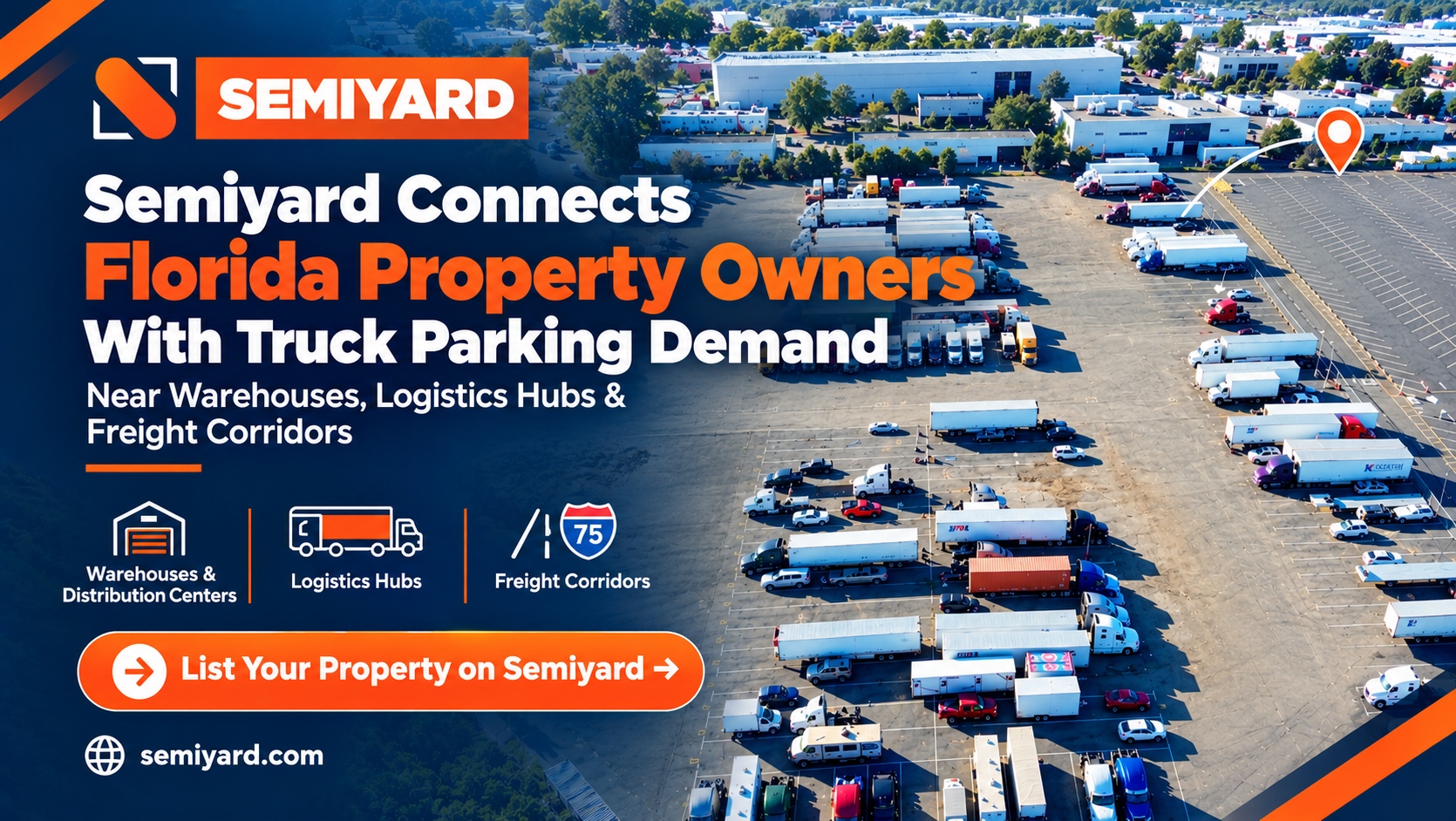




If you own vacant land, an extra section of an industrial lot, or a commercial property that sits mostly empty near a Florida warehouse district or highway interchange, you’ve probably never thought of it as anything other than “the part of the property we’re not using.” For a lot of Florida owners, that’s about to change — not because of a guaranteed windfall, but because the state’s freight and logistics activity has grown to the point where nearby unused space is worth a second look.
Florida moves an enormous amount of freight. Warehouses keep expanding along the I-4 corridor between Tampa and Orlando. Distribution centers cluster around Jacksonville, Lakeland, and Ocala. Ports in Miami, Fort Lauderdale, Tampa, and Jacksonville keep containers moving inland by truck. All of that activity depends on commercial trucks — and commercial trucks need somewhere to stop, stage, rest, or drop a trailer when they’re not moving. That need doesn’t disappear at the warehouse gate or the port terminal fence. It spills out into the surrounding area, onto shoulders, into overflow lots, and — increasingly — onto private property that happens to be in the right location.
This is where property owners start asking a reasonable question: could my unused or underutilized land potentially be suitable for truck or trailer parking, and if so, how would I even connect with the businesses or drivers who need it? This article walks through the industry context behind that question, the practical factors that affect suitability, the zoning and regulatory groundwork every owner should do first, and how a platform like Semiyard fits into the picture as a way to put a listed property in front of a trucking-focused audience — without promising that any particular property will attract bookings, tenants, or income.
Table of Contents
ToggleWhy Truck Parking Can Be a Property Opportunity in Florida
Florida’s freight economy is not a minor piece of the state’s activity. According to the Florida Department of Transportation, the department has identified roughly $6 billion in freight-coded projects in its adopted work program and has programmed nearly $16.9 billion of Strategic Intermodal System funding touching freight priorities such as port access, truck parking, and interchange improvements. That level of state investment reflects how much of Florida’s economy — retail, construction, agriculture, manufacturing, e-commerce fulfillment — depends on trucks physically moving goods from ports and warehouses to their final destination.
Most of that freight moves by highway. State officials have noted that truck drivers are responsible for delivering nearly 80% of Florida’s freight, and Governor Ron DeSantis’s office has cited a similar figure, noting that 75 percent of Florida’s total freight is moved by trucks. Every one of those trucks eventually needs to stop — for a federally mandated rest break, for an overnight layover between deliveries, to stage before a warehouse appointment, or simply to drop a trailer while the tractor runs another load.
The problem is that truck parking supply hasn’t kept pace with that volume. This isn’t a fringe concern or a talking point invented by real estate marketers — it’s one of the most consistently documented issues in American trucking. The American Transportation Research Institute, the research arm of the American Trucking Associations, has tracked truck parking as a persistent industry concern for a decade running. Florida’s own numbers illustrate the gap directly: FDOT’s Freight Mobility and Trade Plan has identified the I-4 corridor as the area of the state most in need of truck parking, and separate reporting has cited FDOT figures putting Florida’s overall truck parking facility demand at near 85% for truck stops and roughly 50% at rest areas statewide.
That imbalance is why the state has been funding new capacity directly. FDOT has announced plans to build a new 100-space truck parking facility in Polk County at the Polk Parkway and I-4 interchange, and in 2026 broke ground on additional dedicated parking along the I-4 corridor, which federal officials described as having the highest unmet demand in the state. Public investment of that kind doesn’t happen without a genuine, well-documented shortage behind it.
None of this means every vacant lot near a highway will suddenly become valuable, or that truck parking demand will materialize automatically. What it does mean is that in specific pockets of the state — particularly near freight-generating land uses — there’s a documented mismatch between how many trucks need to park and how much legal, secure space exists for them to do it. For property owners with land that isn’t being used for anything else, that mismatch is worth understanding, even if the right conclusion for any individual property is “not a fit right now.”
Why Property Near Warehouses and Logistics Hubs Matters
The relationship between freight infrastructure and truck parking demand follows a fairly direct chain: warehouses generate truck trips, those trucks move freight along regional highways, drivers operating under federal hours-of-service rules eventually need to stop, and the areas immediately around distribution activity are where that need tends to concentrate — simply because that’s where the trucks already are.
Warehouses and fulfillment centers schedule deliveries and pickups in appointment windows. A driver who arrives early, finishes a drop unexpectedly late, or has to wait for the next available dock slot often needs somewhere nearby to sit for an hour, an evening, or longer — not necessarily back out on the highway. Distribution centers and industrial parks generate a steady rhythm of inbound and outbound trailers, and fleets serving those facilities sometimes need overflow space to store trailers between loads rather than tying up dock doors. Freight terminals and intermodal yards near ports create similar patterns, with drayage trucks moving containers to and from rail and marine terminals throughout the day. Major highways and interchanges are where all of this traffic funnels together, which is part of why FDOT’s own truck parking studies focus heavily on corridor-level demand rather than treating parking as a purely local issue.
This is also why proximity matters more than raw land size. A ten-acre parcel in a rural area with no nearby freight activity may have far less relevant demand than a much smaller lot positioned near an active distribution cluster or a busy interchange. That said, proximity to freight activity is a factor to evaluate, not a guarantee. Being near a warehouse doesn’t automatically mean a property is a good candidate for parking — access, zoning, and site conditions still have to work, and demand in any given micro-market can vary based on factors an individual owner can’t control, including how much competing capacity already exists nearby.
Florida’s geography adds a layer of specificity here. The I-4 corridor connecting Tampa and Orlando has become one of the state’s most active logistics spines, anchored by warehouse growth in Polk County and the broader Lakeland market — often cited in industry coverage as a distribution hub because of its position roughly midway between Tampa and Orlando. I-75 and I-95 carry heavy north-south freight traffic along the state’s interior and coastal sides, respectively, linking Jacksonville’s port and distribution complex down through Ocala, and through the dense industrial areas around Miami and Fort Lauderdale. I-10 handles freight moving east-west through the Panhandle toward Jacksonville. Florida’s Turnpike ties several of these corridors together, and FDOT has specifically deployed truck parking monitoring technology — its Truck Parking Availability System — along I-4, I-10, I-75, and I-95 at welcome centers, weigh stations, and rest areas, which itself signals where the state considers demand highest.
None of this establishes that one Florida market is definitively “best” for truck parking — that would depend on localized supply, zoning, and demand data that changes over time and varies block by block. What it does establish is that Florida’s major freight corridors and the industrial and warehouse clusters along them are the general geography where the parking shortage is most concentrated, and therefore where a property owner’s proximity is most likely to be relevant.
What Types of Florida Properties Could Be Worth Evaluating?
Not every underutilized property is a candidate, and not every candidate will end up being suitable. But several categories of Florida property are worth a closer look if they sit within a reasonable distance of freight activity:
Vacant commercial land. Undeveloped commercial-zoned parcels — especially those with existing paving, gravel, or a stabilized surface — often require less upfront work than raw land.
Unused portions of industrial properties. Many industrial owners use only part of their site for active operations, leaving side yards, back lots, or overflow areas sitting empty. If zoning and access allow it, that unused portion may be worth evaluating separately from the operating business.
Underutilized warehouse lots. Warehouse sites are sometimes built with more paved yard space than the current tenant needs, particularly on properties that were designed for larger trailer staging than the business currently uses.
Former commercial lots. Closed retail pads, former truck stops, or vacant former dealership lots sometimes already have the paving, lighting, and access infrastructure that truck parking requires, even if the original use is long gone.
Large paved areas near freight generators. Overflow lots near distribution parks, or parcels adjacent to industrial subdivisions, can be relevant even if they were never built specifically for trucking.
Properties near freight corridors and interchanges. Land near highway on/off-ramps along I-4, I-75, I-95, I-10, or the Turnpike is worth evaluating for accessibility, even when it isn’t directly inside a warehouse cluster.
Properties near warehouse and logistics clusters. Land near active fulfillment centers, cold storage facilities, or industrial parks may see relevant traffic simply by virtue of nearby freight activity.
In every case, suitability isn’t just about location. It comes down to whether the physical site and the local rules actually support the use — which is the next question every owner needs to work through.
What Makes a Property Potentially Suitable for Truck Parking?
Before assuming a property is a fit, it helps to walk the site with a practical checklist in mind. None of these factors guarantees suitability on its own, and a property can fail on one point and still be workable if it’s strong elsewhere — but these are the categories that typically come up:
- Location relative to freight activity. Distance from warehouses, distribution centers, industrial parks, ports, or major interchanges.
- Highway and road access. How directly a truck can reach the property from a state road or highway without navigating tight residential streets or low-clearance obstacles.
- Road and pavement condition. Whether the approach roads and the property’s internal surface can handle the weight and turning radius of tractor-trailers.
- Lot size and shape. Enough usable area for the number of vehicles intended, with a layout that isn’t cut up by irregular boundaries or easements.
- Truck maneuverability. Adequate turning radius for trucks to enter, back into a space, and exit without multi-point turns in tight areas.
- Surface type. Paved, compacted gravel, or stabilized surfaces generally hold up better than loose or unstabilized ground, particularly during Florida’s rainy season.
- Drainage. Florida’s heavy seasonal rainfall makes stormwater management a real site consideration — standing water or poor drainage can make a lot unusable for stretches of the year.
- Entry and exit configuration. Clear, safe points of ingress and egress, ideally separated if truck volume is expected to be meaningful.
- Lighting. Adequate lighting supports both safety and practical usability for overnight parking.
- Fencing and gating. Perimeter security is a common expectation for trailer storage and overnight parking in particular.
- Available space and capacity. A realistic count of how many trucks or trailers the site can actually accommodate once circulation space is factored in.
- Neighboring land uses. Adjacent residential areas, noise-sensitive uses, or incompatible neighbors can create friction even where zoning technically allows commercial vehicle parking.
- Zoning and permitted use. Whether the property’s zoning classification actually allows commercial vehicle or trailer parking as a use.
- Local approvals. Whether a special exception, conditional use permit, or other local sign-off is required before the use can begin.
- Operating considerations. Practical questions like whether the site will be staffed, gated, monitored, or self-service, and how access will be managed.
Owners should treat this as a starting framework, not a final determination — the right next step for most of these items is a site visit and a conversation with the local planning or zoning department, not just a visual assessment from the road.
Florida Zoning and Property Considerations
Zoning is where good intentions run into local reality, and it’s the single factor most likely to determine whether a property can be used for truck or trailer parking at all — regardless of how well-located or physically suitable the site otherwise appears.
Every Florida municipality and county sets its own zoning code, and there is no statewide standard that automatically permits commercial vehicle parking on a given parcel. Before doing anything else, a property owner should verify:
- Zoning classification. Whether the parcel is zoned for a use that includes vehicle or trailer parking, and whether that use is permitted by right or requires additional approval.
- Permitted and conditional uses. Many jurisdictions allow truck parking only as a conditional or special-exception use, which typically requires a public hearing or additional review.
- Parking-specific regulations. Some local codes address commercial vehicle parking separately from general parking requirements, including surface, setback, screening, or landscaping standards.
- Commercial vehicle restrictions. Certain residential and mixed-use zoning categories explicitly prohibit overnight parking of tractor-trailers or heavy trucks, even temporarily.
- Local ordinances. City and county codes can include noise ordinances, hours-of-operation restrictions, or nuisance provisions that affect how a lot can be used.
- Access and driveway requirements. Local public works or engineering departments may require permitted driveway modifications for commercial truck access.
- Permitting. Site plan approval, stormwater permitting, or building permits may be required depending on the scope of any site improvements.
- Environmental considerations. Wetlands, flood zones, and stormwater regulations are common in Florida and can affect what site work is allowed.
- HOA or deed restrictions. Even where zoning allows a use, private deed restrictions or a homeowners’ or property owners’ association can independently prohibit it.
Requirements vary significantly by municipality and county — what’s permitted in unincorporated Polk County may be handled very differently in Jacksonville’s Duval County zoning code, or in a Miami-Dade industrial district. The only reliable way to confirm what applies to a specific parcel is to contact the local planning or zoning department directly, and in some cases it’s worth consulting a land use attorney or local permitting professional before committing time or money to preparing a property. Nothing in this article should be treated as legal advice, and owners should not assume a property is approved for truck parking use simply because it’s near an industrial area or highway.
How Semiyard Connects Florida Property Owners With Truck Parking Demand
Once an owner has a realistic sense of whether a property might work — physically and from a zoning standpoint — the next question is practical: how does a property actually get in front of the businesses and drivers who are looking for parking?
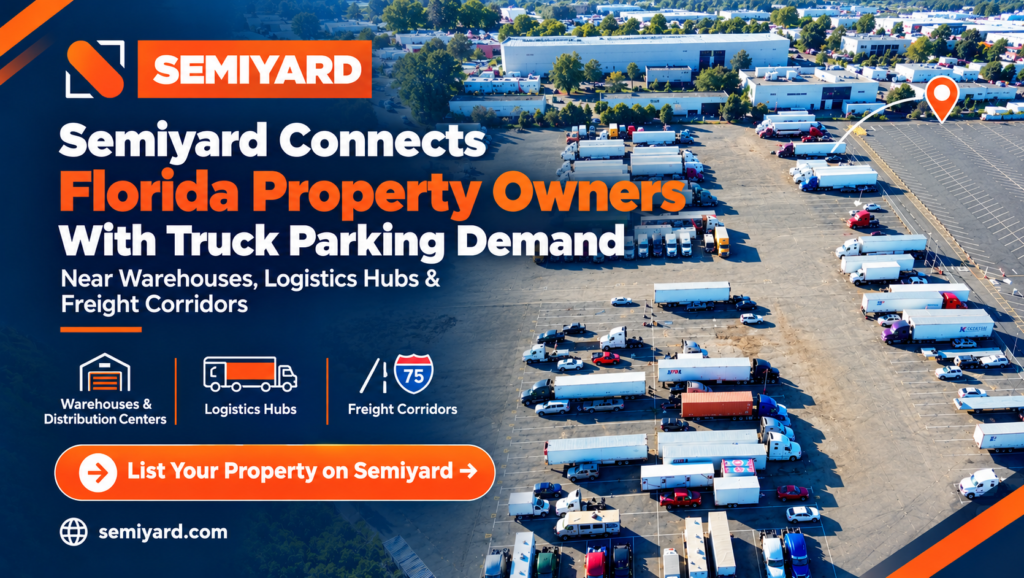
This is the gap Semiyard is built to address. Semiyard is an online platform that connects property owners — including owners of vacant lots, industrial yards, and underutilized commercial land — with truck and trailer drivers, fleets, and carriers actively searching for parking or storage space. Rather than functioning as a general real estate listing service, Semiyard is built specifically around the trucking use case, which means the audience seeing a listing is already looking for exactly that kind of space.
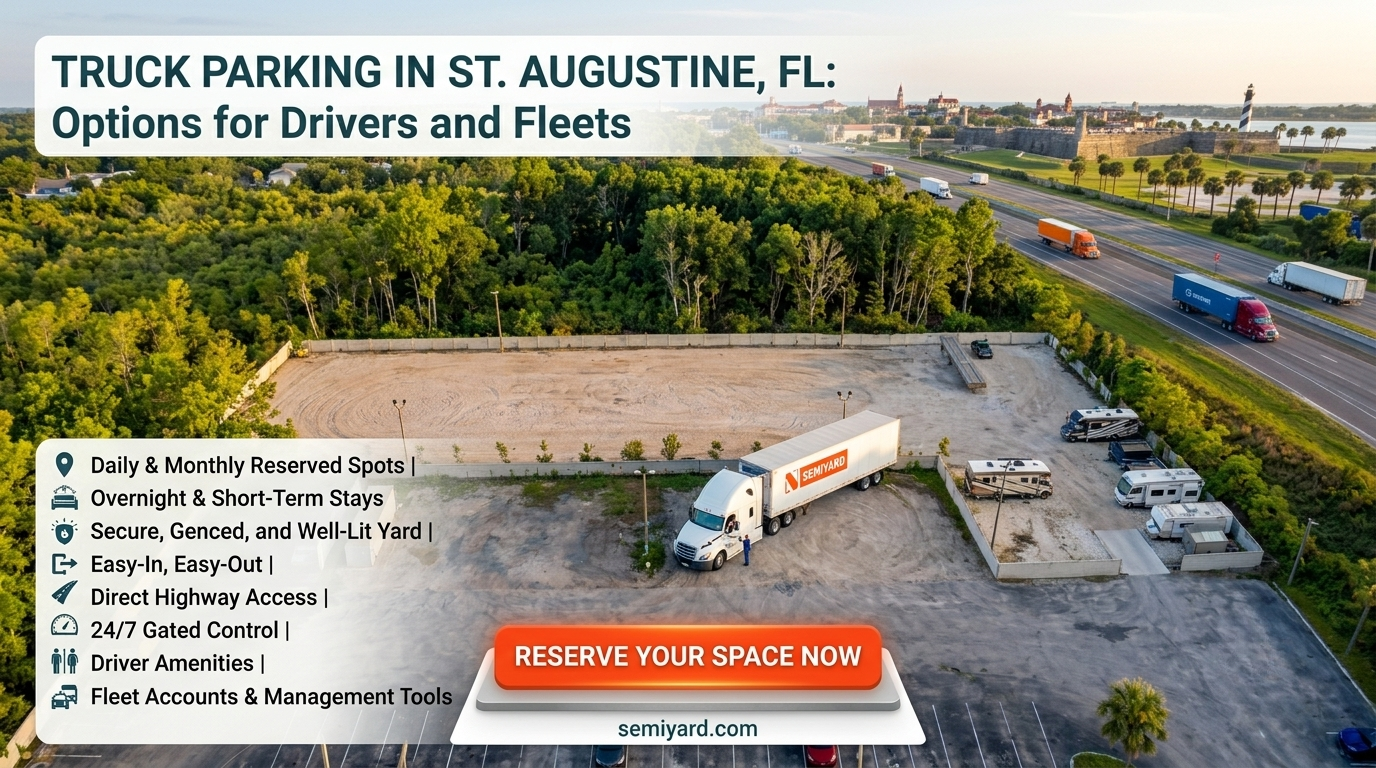
The mechanics are straightforward. A property owner creates a listing that includes the property’s location, available space, and terms — whether that’s nightly, weekly, or monthly parking, or longer-term trailer storage. A complete listing typically includes practical details drivers and fleets actually use to evaluate a spot: the exact address and proximity to major roads, how many trucks or trailers the space can accommodate, whether it’s suited to tractor parking, trailer drop, or both, and amenities like security cameras, lighting, fencing, or 24/7 access. Photos of the entrance, parking area, and any additional site features help potential users evaluate a property before reaching out.
Because the platform is location-based, listings become visible to truckers and fleets actively searching for parking in a given area — including drivers working Florida’s major freight corridors who may be looking for a place to stop near I-4, I-75, I-95, I-10, or a specific warehouse or port district. Semiyard also offers a Truck Parking App that supports this same search-and-discovery process for drivers on the road, which is part of how listed properties get surfaced to the trucking audience actively looking for space in a given market.
It’s worth being direct about what this does and doesn’t mean. Demand varies by location, by season, by how a listing is presented, and by local market conditions the platform doesn’t control. What Semiyard provides is visibility and a dedicated place to present accurate property information to a relevant audience — connecting supply and demand more directly than word of mouth or a generic listing site aimed at a broader real estate audience.
Why Semiyard Matters to Property Owners
For an owner sitting on unused or underutilized space, the practical value of a platform like Semiyard comes down to a few things:
Reaching a trucking-focused audience. Rather than marketing a property broadly and hoping the right person happens to see it, a Semiyard listing is presented to users who are specifically searching for truck or trailer parking.
Giving available property real visibility. Space that would otherwise sit unlisted and effectively invisible to potential users gets a dedicated presence where interested drivers and fleets are actually looking.
A dedicated place to present property details. Location, capacity, surface type, security features, and pricing terms can all be laid out clearly, rather than relying on a phone call or word of mouth to explain what a property offers.
A more relevant listing process. Because the platform is purpose-built around truck and trailer parking, the listing fields and audience are aligned with what an owner is actually trying to offer — rather than adapting a general commercial real estate listing to a use it wasn’t designed for.
A way to explore a potential new use for existing space. For property that isn’t generating any current use or income, listing it is a low-friction way to find out whether there’s relevant interest — without committing to a full redevelopment or a long-term lease before knowing whether the location and site actually attract demand.
None of this changes the underlying homework an owner needs to do first — zoning verification, site assessment, and a clear-eyed look at access and neighboring land uses all come before a listing, not after.
Getting Started: Evaluating and Listing Your Florida Property
For a Florida property owner considering whether truck or trailer parking might be worth exploring, a reasonable sequence looks something like this:
- Confirm zoning and permitted use with the local planning or zoning department before doing anything else.
- Walk the property and assess it honestly against the practical factors above — access, surface, drainage, lighting, fencing, and available space.
- Check for deed restrictions or HOA rules that might apply independently of zoning.
- Consider what site improvements, if any, would be needed to make the property usable and safe, and whether that investment makes sense given the property’s location and condition.
- Gather accurate property information — dimensions, access points, capacity, and any existing security or lighting features — to support a clear, honest listing.
- Create a listing on Semiyard with accurate details and photos, so the property is visible to truckers and fleets actively searching for parking in the area.
Florida’s freight corridors, warehouse markets, and port-adjacent industrial areas will keep generating truck movement, and the parking shortage behind that movement is well documented by the state’s own transportation agencies. That doesn’t mean every unused lot is a fit — zoning, access, and site conditions still decide that on a property-by-property basis. But for owners with land that isn’t doing anything else right now, it’s a reasonable enough question to actually look into: is this property, in this location, worth evaluating for truck or trailer parking — and if it is, is it listed anywhere the right audience would ever see it?