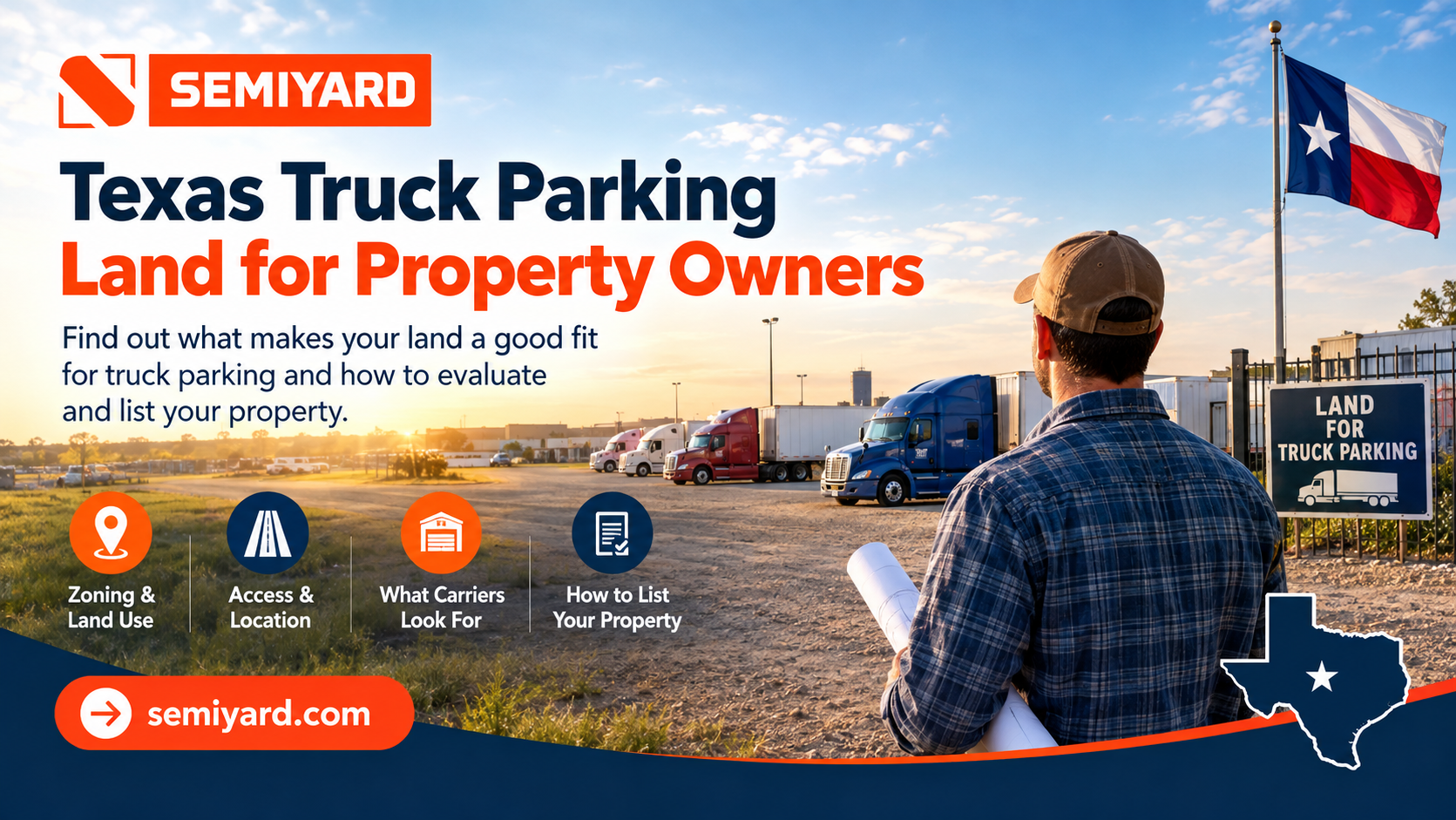



A vacant lot near a highway interchange, a half-empty commercial yard, or a few unused acres behind a warehouse doesn’t generate revenue by sitting there — it generates a tax bill. For property owners across Texas, that gap between what land costs to hold and what it currently produces is a familiar frustration. Meanwhile, in the same state, truck drivers are often circling exits looking for a legal place to stop for the night.
Texas has the largest and most studied truck parking shortage in the country. The state’s own transportation department has spent years documenting exactly where trucks can’t find parking and why it matters. That gap is the starting point for this guide, which is meant for landowners, commercial property owners, industrial property owners, warehouse operators, developers, and investors who are asking a simple question: could this property work for truck or trailer parking, and what would that actually involve?
This isn’t a sales pitch. It’s a practical look at what makes a Texas property worth evaluating, what doesn’t, and what an owner should check before assuming anything.
Table of Contents
ToggleWhy Truck Parking Could Be an Opportunity for Texas Property Owners
Texas moves an enormous share of the country’s freight. Texas has been highlighted as the nation’s leading state in trade, with Port Laredo ranking first in the U.S. for total trade value, and the state accounts for roughly 20% of the country’s trade across its 32 official ports of entry and two intermodal logistics facilities. That volume of freight requires trucks — and trucks require somewhere to stop, whether for a mandated rest break, an overnight layover, or simply to park a trailer between loads.
TxDOT has quantified the resulting shortage in detail. The state’s Statewide Truck Parking Study identified 1,887 miles of highway freight corridors where parking needs were designated highest priority, and the study projected that by 2050, high-priority segments could include 30% of I-10’s miles in Texas, a quarter of I-20, and almost half of I-35’s north-south mileage. That’s not a niche problem confined to one corridor — it spans the major highways that carry freight across the entire state.
The practical result: private, well-located land can play a role that public rest areas and truck stops alone don’t cover. Southeast Texas alone has been documented with 116 private truck parking facilities providing an estimated 7,133 spaces — a reminder that private lots are already a meaningful part of how the state’s truck parking supply works, not a hypothetical add-on. This is a “may” and “could” opportunity, not a guarantee — suitability depends heavily on the specific property, and not every lot near a highway is a fit. But the underlying demand pattern in Texas is well documented, which is more than can be said for most states.
Why Property Near Warehouses and Distribution Centers Matters
Distribution centers and warehouses generate constant truck movement — inbound deliveries, outbound shipments, drop-and-hook trailer exchanges, and drivers waiting for their next dispatch. A property near this kind of activity can be relevant for a few practical reasons:
Trucks serving nearby warehouses often need a place to stage before or after a delivery window, particularly when a facility has limited dock space or restricted overnight parking on-site. Drivers running regional routes out of a distribution hub may also need overnight parking close to where their next load originates, rather than driving extra miles out of the way. And trailers themselves — separate from the tractors pulling them — frequently need storage between loads, which doesn’t always require the same site as a warehouse’s own yard.
None of this means every lot within a few miles of a warehouse is automatically suitable. It means proximity to consistent freight activity is one of several factors worth weighing, alongside access and site condition, which are covered below.
Why Logistics Hubs and Freight Corridors Can Influence Truck Parking Demand
Texas’s freight geography is unusually concentrated around a handful of hubs, and that concentration is well documented rather than anecdotal.
Laredo is the clearest example. U.S. Census Bureau data from 2023 showed the Port of Laredo handling an aggregate amount of product valued at about $320 billion, the most of any port in the country by that metric, and the Port of Laredo sees more than 5.5 million truck crossings per year, with 660 trucking and transportation companies and 250 freight forwarders based in the city. Laredo’s position along I-35 gives it direct connectivity as the most efficient crossing point between the U.S. and Mexico. Property near I-35 in and around Laredo sits inside one of the densest cross-border truck corridors in North America — which is exactly the kind of corridor TxDOT’s study flagged for parking pressure.
Houston carries a different kind of freight weight. Port Houston ranks first in the U.S. for foreign waterborne tonnage and handles more export cargo than any other American port, and the Houston Ship Channel is a 52-mile industrial corridor lined with the highest concentration of refineries and petrochemical plants in the world, which generates significant tanker, flatbed, and specialized freight volume. Property near I-10, I-45, or the Ship Channel corridor sits close to that activity.
Dallas-Fort Worth functions as a major inland distribution and intermodal hub, and Dallas Fort Worth International Airport represents roughly 72% of the state’s airport and intermodal trade — a reflection of how much freight, not just passenger traffic, moves through the region. Land along I-35, I-20, or I-30 in the Metroplex sits inside a hub with heavy regional and long-haul truck movement.
San Antonio, positioned along I-35 and I-10 between Laredo and the rest of the state, also functions as a pass-through point for a large share of cross-border freight heading north and east.
The common thread across all of these regions: proximity to a freight corridor or hub doesn’t guarantee demand for a specific property, but it’s the difference between a lot that’s plausible to evaluate and one that almost certainly isn’t. A parcel forty minutes from the nearest interstate and with no freight activity nearby is a different conversation than one adjacent to I-35 in Laredo or off the Ship Channel corridor in Houston.
What Types of Properties May Be Worth Evaluating?
Several categories of property come up regularly in this context:
- Vacant land — undeveloped acreage near a highway, industrial area, or freight corridor
- Commercial lots — paved or gravel lots with excess capacity beyond current use
- Industrial property — land adjacent to manufacturing, warehousing, or freight operations
- Warehouse-adjacent land — extra acreage owned alongside a distribution facility
- Underused parking areas — portions of larger commercial lots that sit empty overnight or on weekends
- Large commercial properties — sites with more paved or open area than the current tenant uses
Each of these can be worth a closer look, but “worth evaluating” and “definitely suitable” are different things. The next section covers what actually separates a workable site from one that isn’t.
What Makes a Property Suitable for Truck Parking?
This is where generic advice usually stops short. Suitability comes down to a specific set of physical and regulatory factors, not just being “near a highway.”
Location and access. A property needs a realistic route in and out for a semi-truck — not just proximity to a highway on a map, but an actual entrance that a driver can use without a difficult turn, a low bridge, a weight-restricted local road, or a residential street in between.
Lot size and configuration. Trucks and trailers need more room than passenger vehicles to park, back up, and turn around. A lot’s usable footprint — after accounting for setbacks, drainage, and any existing structures — matters more than its total acreage on paper.
Maneuverability. Turning radius is a real engineering consideration, not a minor detail. A tractor-trailer combination is roughly 70 feet long and needs a wide arc to turn. Tight entrances, sharp corners, or narrow drive aisles can make an otherwise well-located lot impractical.
Surface condition. Gravel, compacted base, or paved surfaces all come up in practice, but each has different durability and drainage implications under repeated heavy-vehicle weight and Texas weather, including intense summer heat and periodic flooding in some regions.
Lighting. Adequate lighting affects both usability after dark and general site security — a factor many drivers and fleets consider when choosing where to park overnight.
Fencing, gates, and access control where applicable. Not every site needs controlled access, but for properties marketed for overnight or extended parking, some level of access management is a common consideration.
Operating hours and access rules. Whether a site is available 24/7, during set hours, or by appointment affects who it’s realistic for — a driver on a tight hours-of-service window needs different access than a fleet storing trailers long-term.
Zoning and local requirements. This is one of the most commonly overlooked steps. Zoning designations, use permits, and local ordinances vary by city and county across Texas, and they determine whether a given parcel can legally be used for vehicle parking or storage at all. This should be verified directly with the relevant local planning or zoning department before assuming a property qualifies — it is not something a general article can confirm on an owner’s behalf.
Proximity to freight activity and highway connectivity, as covered above, rounds out the list — relevant, but only one factor among several.
Areas in Texas Property Owners Should Consider
Given the corridor data above, a few regions stand out for a closer look, without suggesting these are the only options:
- The I-35 corridor, from Laredo through San Antonio, Austin, and up to the DFW area — flagged in TxDOT’s own research, and home to one of the corridors with the most frequent truck parking closures, between Laredo and San Antonio
- The Houston Ship Channel area and I-10/I-45 corridors, reflecting the concentration of petrochemical and export freight moving through Port Houston
- The DFW Metroplex, particularly along I-20, I-30, and I-35, given its role as an inland freight and intermodal hub
- Border regions near Laredo and Eagle Pass, where cross-border truck volume is exceptionally high and, in the case of Eagle Pass, industrial capacity has been noted as underutilized relative to demand
- Secondary freight corridors identified in TxDOT’s studies, including segments of U.S. 59, U.S. 281, and SH 73/87, which the state has flagged for frequent closures and parking pressure
Owners outside these specific corridors shouldn’t assume their property is automatically excluded — but proximity to one of these documented freight-heavy areas is a reasonable starting point for evaluating potential demand.
How Property Owners Can Prepare Their Property
For an owner who concludes a property is worth pursuing, preparation typically involves:
- Evaluate the property honestly. Walk the site with the access, size, and surface questions above in mind, rather than starting from the assumption that it will work.
- Check zoning and local requirements first. Confirm with the local planning or zoning department whether truck or trailer parking is a permitted use, and whether any permit or site plan approval is required.
- Review access and site conditions. Look at the entrance, turning space, surface, drainage, and lighting as they exist today, and note what would need to change.
- Determine suitable vehicle types. A site might work for trailer storage but not overnight tractor-trailer parking, or vice versa, depending on layout and access hours.
- Prepare property information. Gather lot dimensions, address, access points, surface type, available lighting/security features, and any zoning documentation.
- Take clear, well-lit photos. Wide shots of the entrance, the full lot, and any relevant features (gates, lighting, surface) help anyone evaluating the property from a distance.
- Create a detailed listing. Accurate details attract serious inquiries and reduce back-and-forth with drivers or fleets who aren’t a fit.
- Connect with potential users. Once a listing is ready, the goal is putting it in front of truckers, carriers, and fleets who are actively looking for parking in that area.
Questions Property Owners Should Ask Before Listing
- Does local zoning permit vehicle parking or storage on this property, and is a permit needed?
- Can a standard tractor-trailer physically enter, turn around, and exit the site without difficulty?
- What is the current surface condition, and how will it hold up under repeated heavy-vehicle use?
- Is the site accessible 24/7, or only during certain hours?
- Is lighting adequate for after-dark use?
- Is fencing or gated access needed, and is it currently in place?
- How far is the property from the nearest major highway or freight corridor?
- What ongoing maintenance or liability considerations come with allowing third-party vehicle access?
How to List Your Property for Truck Parking
Once an owner has evaluated the site, checked zoning, and gathered accurate property details, the next step is putting that information in front of the people actually looking for parking — truckers, carriers, and fleet operators searching for space near a specific corridor or metro area.
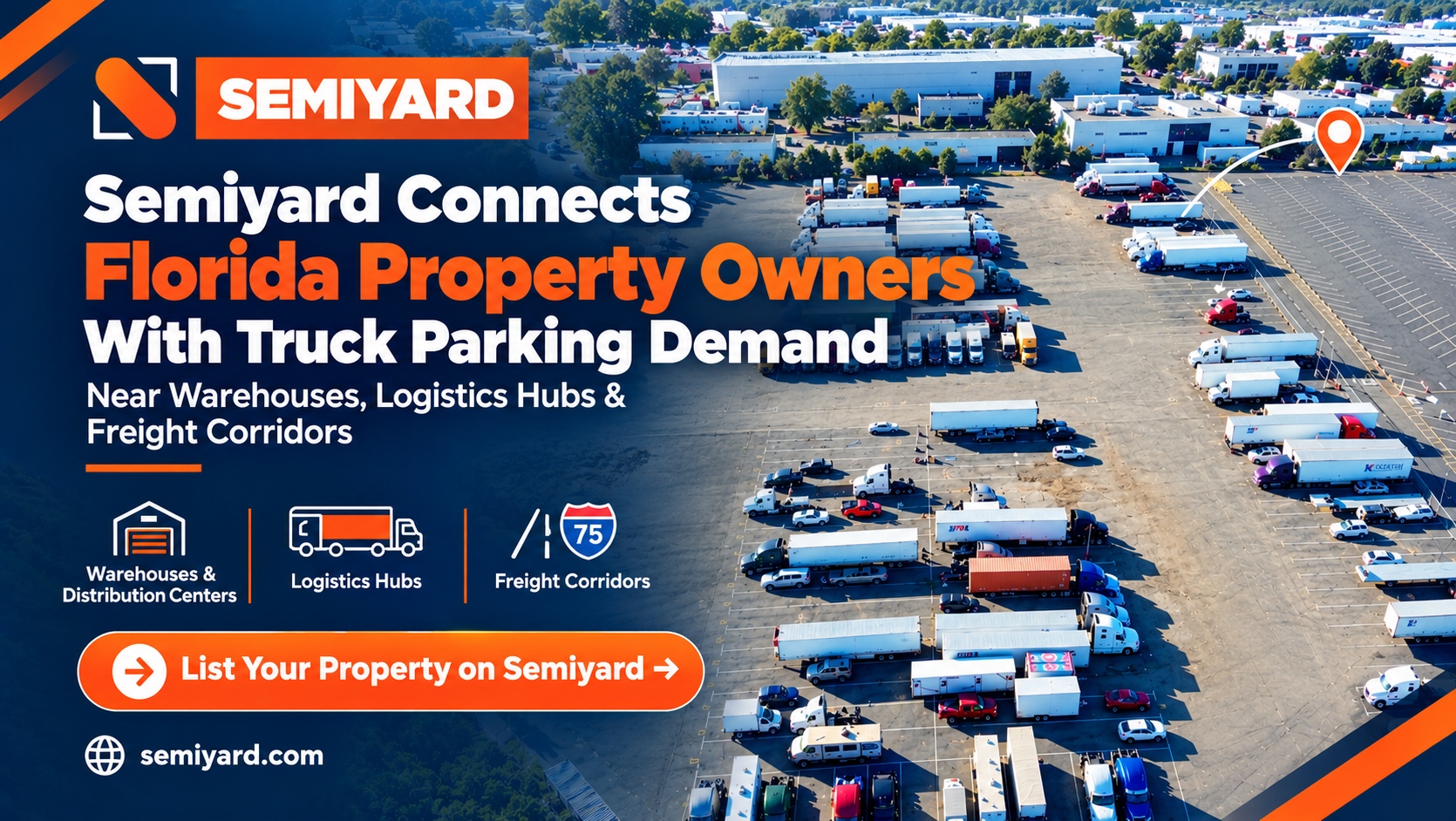
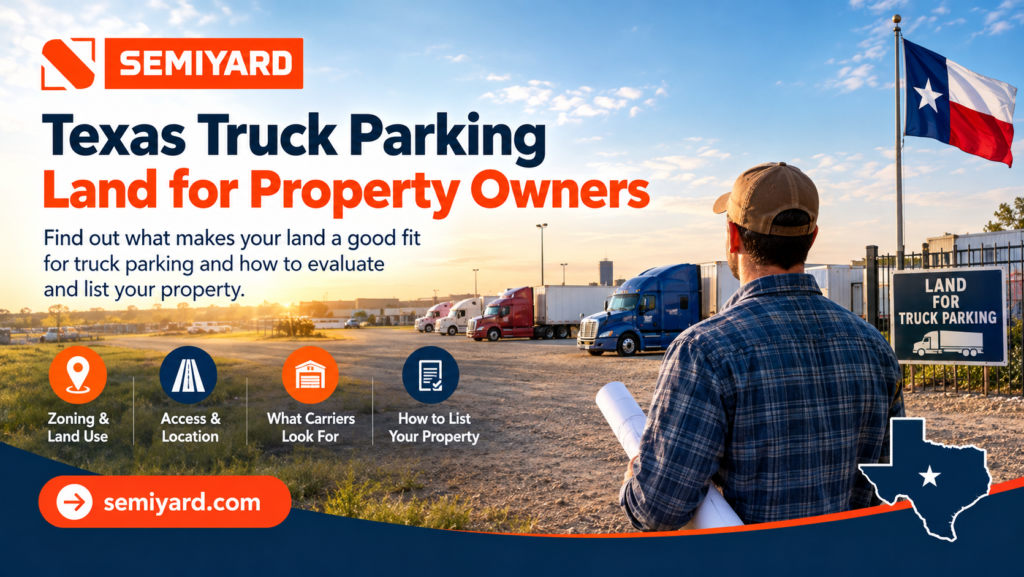
Have unused land or commercial property in Texas? Semiyard gives property owners a way to list available space for truck parking and connect their property with truckers, carriers, and fleets looking for parking options.
List Your Property with Semiyard
Frequently Asked Questions
Does my property need to be directly on a highway to work for truck parking? Not necessarily, but reasonable proximity and easy access to a major road matter. A property tucked behind several turns on narrow local streets is a harder sell than one with a direct connection to a highway frontage road, even if both are the same distance from an interstate.
What size lot is typically needed? It depends on how many vehicles the owner wants to accommodate and how the space is laid out, but tractor-trailers require significantly more turning and parking room than passenger vehicles. A small lot might reasonably fit a handful of trucks; larger sites can accommodate more, depending on configuration.
Does the surface have to be paved? Not always. Gravel or compacted surfaces are used in practice, though they carry different durability and drainage considerations than pavement, particularly under repeated heavy loads and Texas weather conditions.
Do I need to check zoning before listing my property? Yes. Zoning and local permitting requirements vary by city and county in Texas, and they determine whether vehicle parking or storage is a legally permitted use on a given parcel. This should be confirmed directly with the local planning or zoning department.
Will my property definitely generate income if I list it? No property owner should assume guaranteed income, tenants, or demand. Whether a property attracts interest depends on location, access, condition, zoning, and market demand in that specific area, among other factors.
What types of trucks might use my property? This can range from long-haul tractor-trailers needing overnight parking to regional trucks between local deliveries, to trailers being stored between loads without a tractor attached. The right fit depends on the site’s access, size, and configuration.
Is fencing or security required? It’s not universally required, but it’s a common consideration for owners marketing a site for overnight or extended parking, since it affects how comfortable drivers and fleets feel using the space.
How do I know if my property is near enough to freight activity to matter? Look at documented freight corridors and hubs — in Texas, that includes areas near Laredo, Houston, the DFW Metroplex, San Antonio, and the interstate corridors TxDOT has flagged for parking pressure (I-35, I-10, I-20, among others). Proximity to these areas is a reasonable starting point, though it doesn’t guarantee suitability on its own.
Final Takeaway
Texas has one of the most extensively documented truck parking shortages in the country, concentrated along specific corridors and freight hubs that TxDOT has already mapped out. For property owners with vacant land, an underused commercial lot, or extra industrial acreage near one of these areas, that shortage is worth a closer look — not as a guaranteed source of income, but as a use case worth evaluating against the property’s actual access, size, surface, and zoning status.
The right next step isn’t listing a property sight unseen. It’s walking the site, checking with the local zoning department, and being honest about what the lot can and can’t accommodate. For owners who go through that process and find a property that fits, Semiyard provides a way to list it and connect with truckers, carriers, and fleets searching for parking in that area.