


It’s 5:40 a.m. at a truck stop outside Dallas. You just dropped a load, your clock is ticking, and you need the next one before you burn another hour sitting still. So you open a load board, set the origin, pick a radius, choose your trailer type, enter a date, hit search, and start scrolling. No luck. Widen the radius. Try a different delivery state. Scroll again.
That routine is familiar to almost every owner-operator and small-fleet dispatcher in the country. The tools work, but they ask you to think like a database: fill the fields, run the query, repeat.
An AI dispatcher flips that around. Instead of filling out a search form, you type (or ask) what you actually want, in plain English: “Find me reefer loads out of Dallas going toward Atlanta, picking up tomorrow.” The software interprets the request, searches the board, and returns matching freight.
This guide explains what conversational load search is, how it works behind the scenes, what kinds of questions you can ask, and where its limits are. It also covers the part no AI can do for you: deciding whether a load is actually worth hauling.
Table of Contents
ToggleWhy Traditional Load Searching Eats Your Day
Load boards changed trucking for the better. Before them, finding freight meant phone calls, fax sheets, and relationships built over years. But the standard search-and-filter model still has friction, and that friction costs money.
Time spent searching is time not driving
Under FMCSA’s hours-of-service rules, a property-carrying driver can drive up to 11 hours, and can’t drive past the 14th consecutive hour after coming on duty. Off-duty time doesn’t stop that 14-hour clock. Every half hour spent refining searches, calling on stale postings, or waiting on callbacks comes out of a window that doesn’t pause.
Rigid filters miss what you actually mean
A search form only understands what its fields allow. If you want “something heading back toward Memphis, ideally under 500 miles, nothing that picks up before noon,” you have to translate that into origin, destination, radius, date, and trailer type, then manually sort through the results to apply the rest. Drivers often run the same search several times with small changes just to see what turns up.
Empty miles are expensive
The American Transportation Research Institute (ATRI) found the industry-average cost to operate a truck hit a record $2.336 per mile in 2025, according to its 2026 Analysis of the Operational Costs of Trucking. The same report put non-tank deadhead at 16.5% of miles and noted that empty mileage can be the single greatest drain on operating costs. Finding a reload or backhaul quickly is one of the few levers a small carrier fully controls.
Too many tabs, too many tools
Many owner-operators juggle a load board, a rate tool, a mapping app, broker emails, and a notes app. Small brokers do the same on the other side, posting loads in one place and vetting carriers in another. Switching between them slows decisions down, especially from a phone in the cab.
What Is an AI Dispatcher?
An AI dispatcher is a conversational assistant built into a load board or transportation management system (TMS). You ask for freight in everyday language, and it turns that request into a structured search.
It helps to be clear about what it is not. It isn’t a human dispatcher who negotiates rates, calls brokers, or manages your paperwork. It’s a faster, more natural way to search and sort freight. The decisions stay with you.
How conversational load search works
Without getting too technical, most AI-assisted search tools follow the same basic sequence:
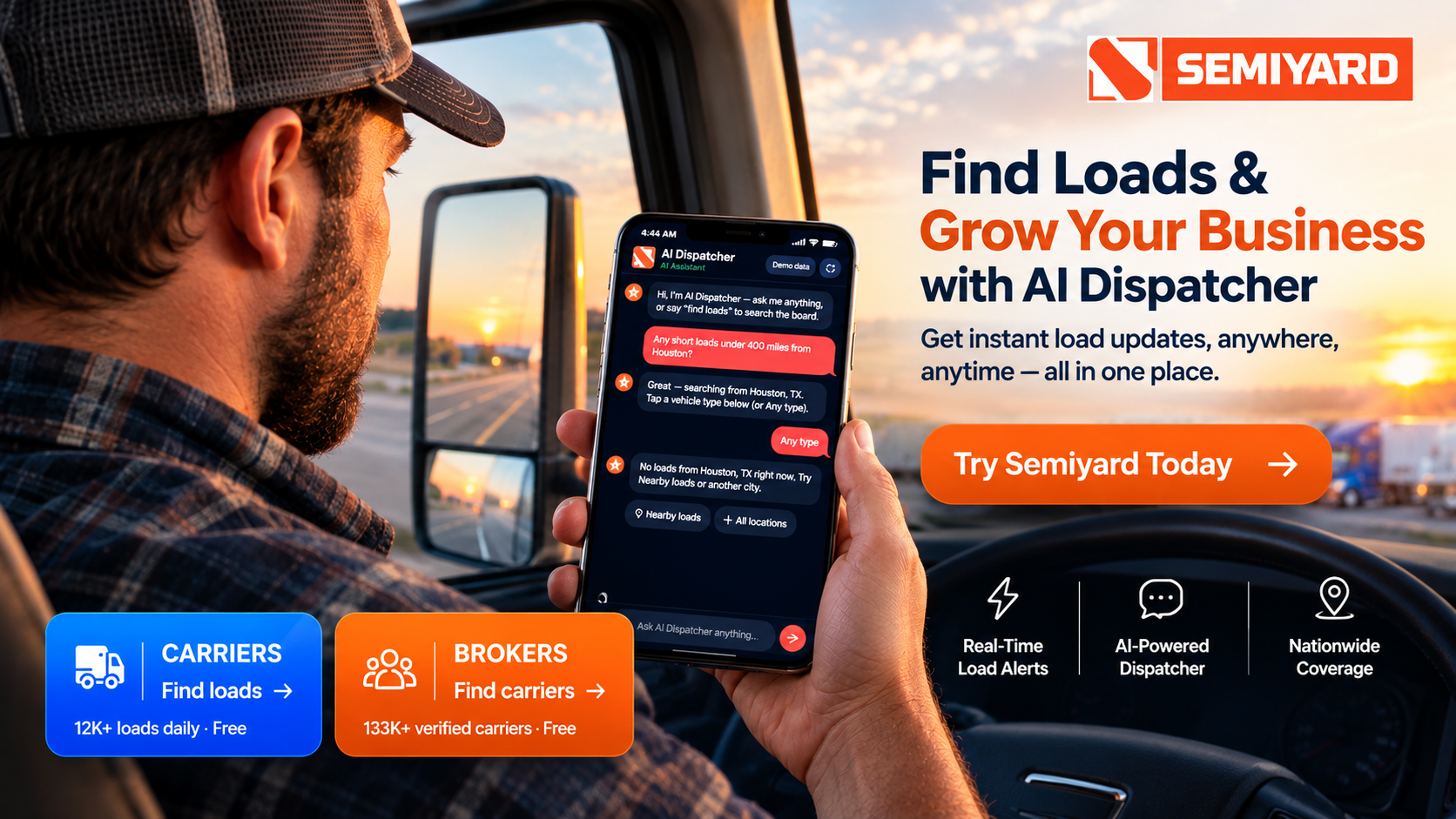
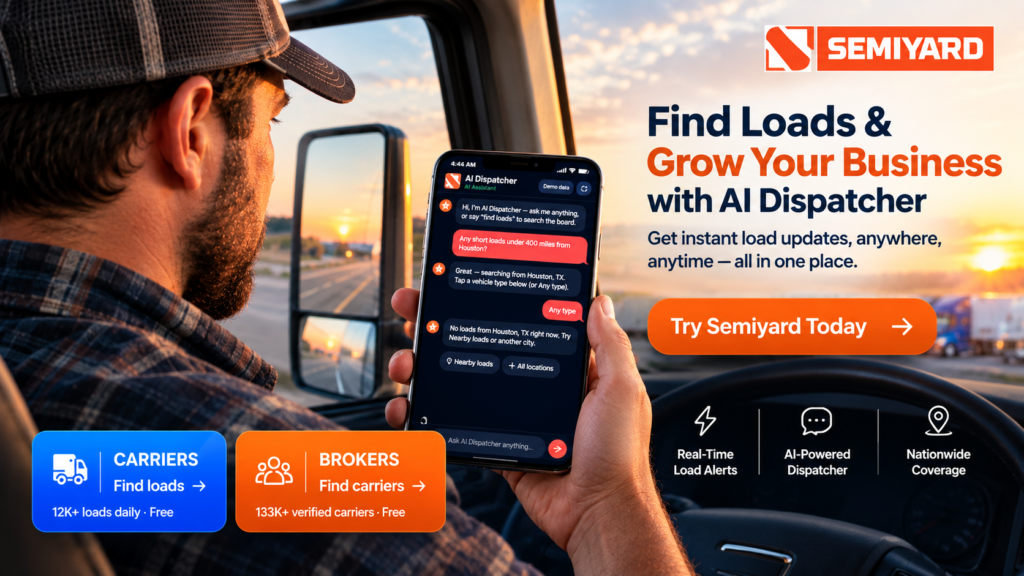
- You ask a question. For example: “Any short loads under 400 miles from Houston?”
- The AI interprets your request. It pulls out the details that matter: origin (Houston), distance limit (under 400 miles), and the fact that you want available loads.
- It converts that into search criteria. Those details become the same filters you’d otherwise set by hand, like pickup location, radius, and trip length.
- It searches the board. The system checks current listings against your criteria.
- It returns results you can review. You see matching loads, then open the details to check rate, schedule, and broker before deciding anything.
Example: one question, start to finish
Say you just delivered in Houston and type: “Any short loads under 400 miles from Houston?”
Here’s what the AI dispatcher does with that one sentence, compared with doing it by hand:
|
What you meant |
What you’d do on a standard search form |
What the AI dispatcher handles |
|---|---|---|
|
Start near Houston |
Type the origin, pick Houston, TX, set a pickup radius |
Reads “from Houston” as the pickup location |
|
Short trips only |
Run the search, then scan each result’s mileage yourself |
Reads “under 400 miles” as a trip-length limit |
|
Any trailer, any date |
Leave filters on “any” and hope results aren’t too broad |
Applies no extra limits you didn’t ask for |
|
See what’s available |
Click search, scroll, refine, repeat |
Returns the matching loads in one reply |
With conversational search, you can often refine with a follow-up instead of starting over. A follow-up like “Just reefer, picking up tomorrow” narrows the same results. “Anything heading toward San Antonio?” points you toward a lane you’d like to end up in.
The result is a shortlist, not a decision. You still open each load to check the rate, deadhead to the pickup, appointment times, and the broker, which the checklist later in this article walks through.
The underlying technology is usually a large language model (LLM), the same type of AI behind popular chat assistants, connected to the load board’s live data. The language model handles understanding; the load board supplies the actual freight.
Why that combination matters
A general-purpose chatbot can talk about trucking, but it can’t see real loads. An AI dispatcher connected to a board’s listings can answer with actual freight. That connection to real data is what makes it useful rather than just conversational.
Example Questions You Can Ask an AI Dispatcher
The best requests sound like what you’d tell a good human dispatcher: specific about the details that matter to you. Here are realistic examples organized by what you’re searching for.
|
Search need |
Example question |
|---|---|
|
Origin city |
“Show me loads from Dallas, TX.” |
|
Best-paying freight |
“What are the best paying loads on the board right now?” |
|
Short haul |
“Any short loads under 400 miles from Houston?” |
|
Specific lane |
“Find dry van loads from Atlanta to Charlotte.” |
|
Equipment type |
“Any flatbed loads out of Birmingham this week?” |
|
Pickup date |
“Reefer loads picking up in Fresno tomorrow.” |
|
Backhaul |
“I’m delivering in Phoenix Thursday. What’s heading back toward El Paso?” |
|
Radius |
“Loads within 75 miles of Indianapolis.” |
|
Regional preference |
“Step deck freight staying in the Southeast.” |
|
Power only |
“Any power only loads near Joliet?” |
The first three come straight from the sample prompts on Semiyard’s homepage. The rest show the kinds of details worth including. If a request returns too much or too little, rephrase it or switch to the standard search filters.
Tips for getting better results
- Lead with location and equipment. “Reefer out of Fresno” narrows results far faster than “good loads.”
- Add one or two constraints at a time. Start broad, then follow up with “only ones picking up tomorrow” or “under 500 miles.”
- Use real city and state names. “Springfield” could be Illinois, Missouri, or Massachusetts. Adding the state removes the guesswork.
- Always open the full listing. A summary is a starting point. Rate, weight, commodity, and appointment details live in the load itself.
How Semiyard’s AI Dispatcher Fits Into Your Workflow
Semiyard’s load board combines a free load board with an AI-driven TMS for carriers and brokers. It costs $0 per month, with no credit card and no contract required. The AI Dispatcher sits on top of that board, so you can ask for loads in plain language instead of building every search by hand.
For carriers and owner-operators
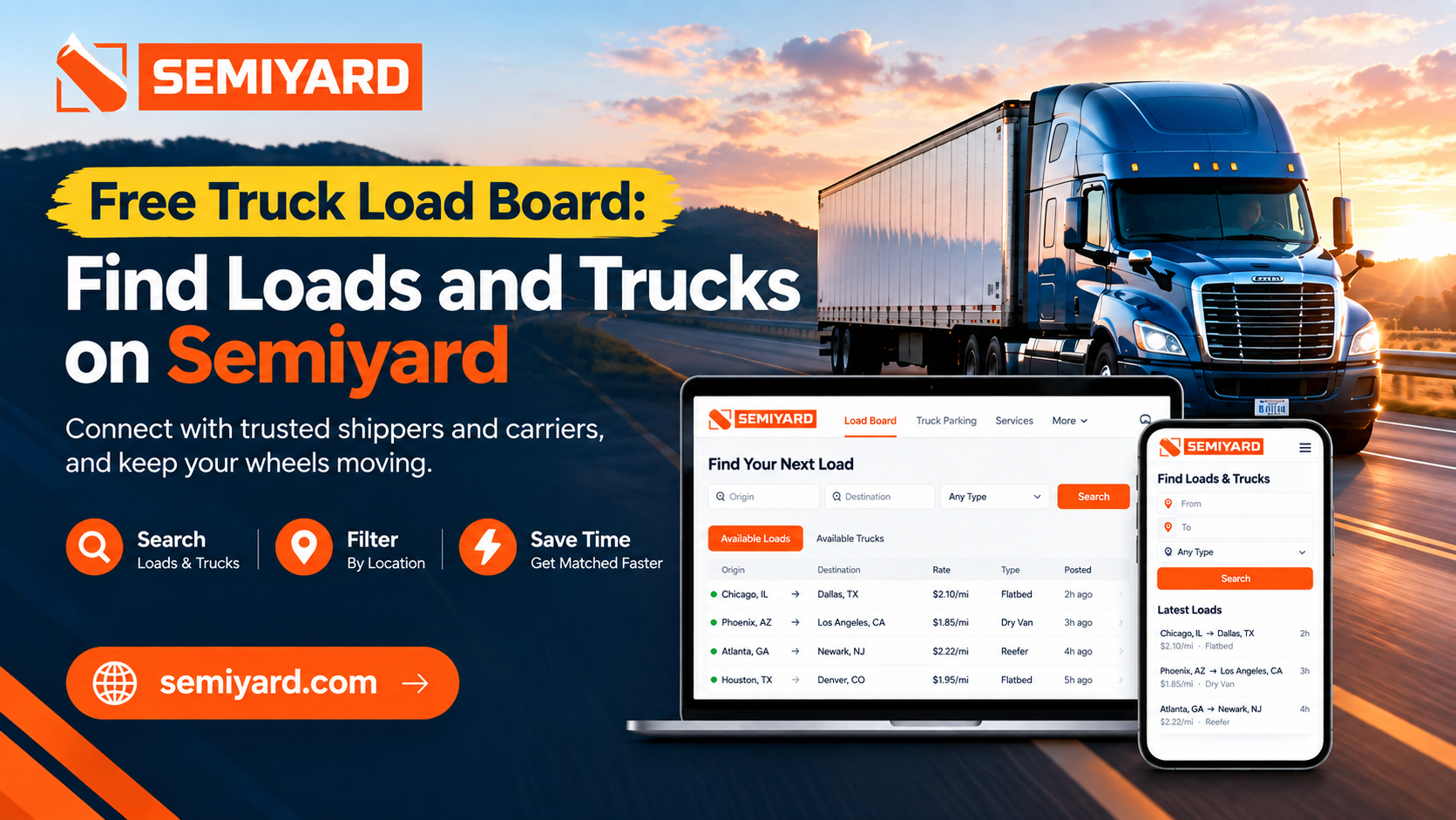
If you prefer filters, those are still there. You can search live loads by pickup and delivery location, pickup and delivery radius, pickup date, and trailer type. Equipment coverage includes dry van, reefer, flatbed, step deck, power only, and more.
A few details that matter day to day:
- You can browse before signing up. The public load board doesn’t require an account, so you can see what’s posted before you commit to anything.
- Bidding stays in your hands. Carriers can submit bids on posted freight, and nothing is booked without your approval.
- Parking is part of the same ecosystem. Semiyard also helps drivers find truck parking, which is useful when you’re planning where to rest before or after a pickup.
For brokers
Brokers can post loads, search carriers by location and equipment, and review bids before moving freight toward booking. Semiyard states that every carrier on its network is manually verified, including checks on driver’s license, DOT, MC, insurance, vehicle photos, and inspection documents, and that overseas operators aren’t permitted. Brokers can also reach carriers parked at Semiyard locations for regular or urgent hauls.
Semiyard currently lists 12K+ loads daily and 133K+ verified carriers on its network.
What to Check Before You Accept Any Load
An AI dispatcher can surface loads faster. It can’t tell you whether a specific load is right for your truck, your clock, and your bank account. That judgment is yours, and it’s worth slowing down for.
1. The real rate, including deadhead
Posted rates are usually quoted on loaded miles. Your costs run on every mile. Here’s a simple hypothetical:
- Load pays $2,000 for 800 loaded miles = $2.50 per loaded mile
- You drive 100 empty miles to pick it up
- Total miles: 900, so the load actually pays about $2.22 per mile driven
That gap is easy to miss when you’re scrolling quickly. Ask the follow-up question every time: how far is the pickup from where my truck is right now?
2. Your own cost per mile
ATRI’s 2025 industry average of $2.336 per mile is a useful benchmark, but it’s an average across many fleet types. Your number depends on your truck payment, insurance, fuel economy, maintenance, and how many miles you run. If you don’t know your cost per mile, calculate it from your last two to three months of actual expenses before judging any rate.
3. Pickup and delivery schedules
Check appointment times against your hours of service. A well-paying load that forces a tight pickup window after a long day, or a delivery appointment that leaves you sitting through a weekend, may not be worth it. Look for:
- Firm appointment vs. first-come, first-served (FCFS)
- Expected detention and whether detention pay is offered
- Lumper or unloading fees, and who pays them
- Where you’ll be when the load delivers, and what freight is available there
4. Load details
Confirm weight, commodity, trailer requirements, and any special handling, such as temperature settings for reefer or tarping and securement for flatbed. Make sure everything you agreed to appears on the rate confirmation before you dispatch.
5. Broker credibility
Freight fraud is a real risk for both carriers and brokers. FMCSA warns that fraud and identity theft happen when someone uses another carrier’s USDOT number without authorization or acts as a broker without FMCSA registration (FMCSA fraud alert). Before booking:
- Look up the broker’s MC or USDOT number on FMCSA’s SAFER Company Snapshot and confirm active authority.
- Call the phone number listed in FMCSA records, not just the number in the email or posting. FMCSA specifically recommends confirming phone numbers through SAFER.
- Check payment history and days-to-pay through your factoring company or a credit service if you use one.
- Be cautious of rates far above market, last-minute changes to pickup details, or pressure to skip normal paperwork.
If you’re a broker, the same logic applies in reverse. Verify carrier authority, insurance, and contact details, even on a network that pre-screens carriers.
Benefits and Limitations of AI-Assisted Load Search
Conversational search is a genuinely useful tool, but it’s still a tool. Here’s a balanced look at what it can and can’t do.
Potential benefits
- Faster first pass. Typing one sentence can replace several rounds of adjusting filters, which may save time when you’re between loads.
- Easier on a phone. A short question is simpler than working through a multi-field form on a small screen.
- Lower learning curve. New owner-operators who don’t yet know every board feature can describe what they need in their own words.
- Quick follow-ups. Narrowing results (“only reefer,” “picking up tomorrow”) feels more like a conversation than starting a new search.
How much time it actually saves depends on your operation, how specific your requests are, and what freight is available. No tool can create loads in a lane where there aren’t any.
Limitations to keep in mind
- It can misread a request. Ambiguous city names, unusual phrasing, or multiple conditions in one sentence can produce results that don’t match what you meant. Glance at the filters it applied.
- It only knows what’s posted. Results depend on the board’s current listings and how accurately they were entered.
- It doesn’t replace due diligence. It won’t vet a broker, check your hours, or calculate your true profit on a load.
- It doesn’t negotiate for you. Rate discussions and final agreements are still between you and the other party.
Where it fits by role
|
Role |
How an AI dispatcher may help |
|---|---|
|
Owner-operator |
Quickly find reloads and backhauls from the cab between deliveries |
|
Small fleet manager |
Scan options for several trucks in different locations without rebuilding each search |
|
In-house dispatcher |
Speed up the first round of load hunting, leaving more time for broker calls and planning |
|
Freight broker |
Pairs with load posting and carrier search on the same platform to keep freight moving |
The Bottom Line: Ask Faster, Decide Carefully
The biggest change an AI dispatcher brings isn’t the technology. It’s the shift from operating a search form to simply saying what you need. For a driver racing the 14-hour clock or a dispatcher covering several trucks at once, that can make the first step of finding freight noticeably smoother.
What doesn’t change is the business side. The best load is still the one that covers your true cost per mile, fits your hours, keeps deadhead in check, and comes from a broker you’ve verified. Let the AI handle the searching. Keep the judgment for yourself.
Try it on Semiyard
Semiyard’s load board and AI-driven TMS are free for carriers and brokers, with no credit card and no contract. You can browse live loads without an account, then sign up when you’re ready to bid or post.
- Carriers: Create a free carrier account to search loads, bid on freight, and find backhauls.
- Brokers: Create a free broker account to post loads and connect with verified carriers.
- On the road: Download the Semiyard app and find truck parking along your route.
Frequently Asked Questions
What is an AI dispatcher for trucking?
An AI dispatcher is a conversational assistant inside a load board or TMS. You ask for freight in plain English, and it converts your request into a search of available loads.
Does an AI dispatcher replace a human dispatcher?
No. It speeds up searching and sorting loads, but it doesn’t negotiate rates, manage paperwork, or make booking decisions. Those remain with the carrier or dispatcher.
Is Semiyard’s load board really free?
Yes. Semiyard lists its load board and AI TMS at $0 per month for carriers and brokers, with no credit card or contract required.
Do I need an account to search loads on Semiyard?
No. You can browse the public load board without signing up. An account is needed to bid, post loads, and use favorites and team tools.
What trailer types can I search for?
Semiyard supports common equipment including dry van, reefer, flatbed, step deck, and power only, with trailer filters to match your truck.
How can I tell whether a load is profitable?
Divide the total pay by all miles driven, including deadhead, and compare that to your own cost per mile. Also factor in tolls, detention risk, and where the load leaves you.
How do I check whether a broker is legitimate?
Look up the broker’s MC or USDOT number on FMCSA’s SAFER Company Snapshot, confirm active authority, and call the phone number listed in FMCSA records before booking.
Can brokers use Semiyard to find carriers?
Yes. Brokers can post loads for free, search carriers by location and equipment, and review bids. Semiyard states that carriers on its network are manually verified.