




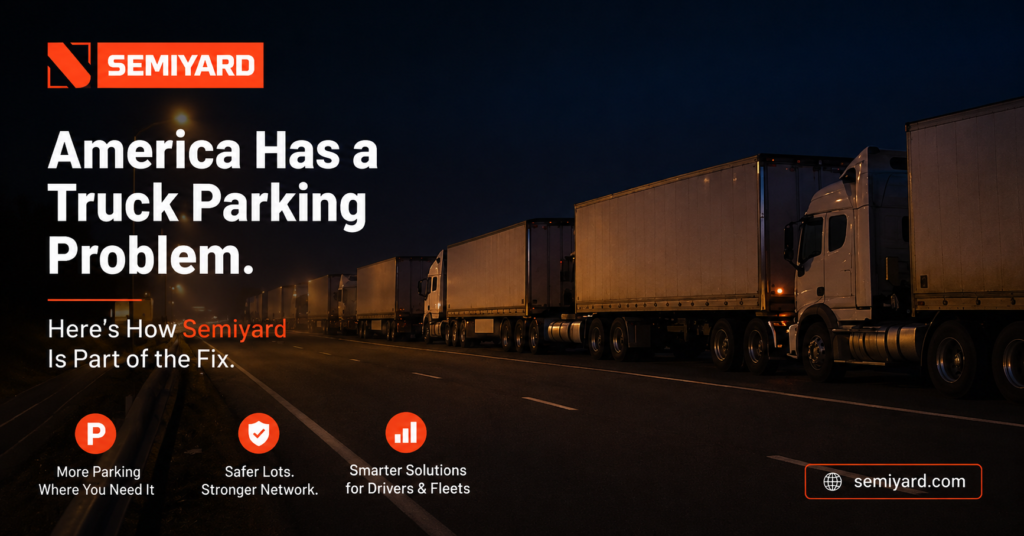
Ask almost any driver what the worst part of the job is, and “finding a place to park” comes up faster than fuel prices or traffic. That’s not a complaint about convenience — it’s a structural problem in American freight infrastructure, and it’s gotten measurably worse over the last decade.
At Semiyard, we didn’t start as a parking company by accident. We started because the data — and the drivers we talked to — made it clear that parking wasn’t a side issue. It was the issue.
Table of Contents
ToggleThe Problem: A Nationwide Shortage With Real Numbers Behind It
This isn’t a perception problem. It’s a math problem.
According to research jointly conducted by the American Transportation Research Institute (ATRI) and the American Association of State Highway and Transportation Officials (AASHTO), the U.S. currently has roughly one truck parking space for every eleven truck drivers on the road nationally. With an estimated 2.4 million trucks competing for around 313,000 total spaces — split between public rest areas and private truck stops — the shortfall isn’t a regional quirk. It shows up on every major freight corridor in the country, from I-95 on the East Coast to I-5 out west and the routes converging on Chicago.
The scale of the problem shows up in how the industry ranks it. ATRI’s ongoing survey of thousands of trucking stakeholders has consistently placed the lack of available parking among the top concerns in the industry overall — and it’s typically the single biggest frustration reported by drivers themselves, ahead of pay and even the driver shortage. A Federal Highway Administration survey of nearly 11,700 truck drivers found that the overwhelming majority — 98% — had experienced problems finding safe parking within their normal operating area.
The imbalance is also structural: roughly 87% of available truck parking sits on private property (truck stops and similar lots), while only about 13% is at public rest areas — which are themselves capped by state funding and land availability. Building new public capacity is expensive, too; the median cost to construct a single new truck parking space runs into the tens of thousands of dollars, which is part of why federal grant programs investing hundreds of millions of dollars into new parking are still only expected to add a few thousand new spaces nationwide.
The human and economic cost of this gap is significant. Drivers forced to burn hours searching for parking lose real income and real Hours of Service — time they can’t get back. And when legal parking isn’t available, drivers are pushed toward shoulders, ramps, and unauthorized lots, turning a logistics problem into a safety one.
Why This Keeps Happening
It’s tempting to treat this as a supply problem alone — just build more spaces. But the barriers are layered:
- Funding gaps at the state level, where budgets for new rest area construction compete with every other transportation priority
- Community pushback against new commercial truck lots near residential areas
- Land scarcity in exactly the freight corridors where parking is needed most
- Freight growth that continues to outpace infrastructure investment, with U.S. freight tonnage projected to keep climbing for decades
Public infrastructure alone isn’t going to close this gap fast enough. That’s where private, flexible solutions — including marketplaces like Semiyard — have started to play a real role.
How Semiyard Fits Into the Fix
Semiyard’s core idea is simple: there’s more usable parking capacity in this country than the public numbers suggest — it’s just sitting underutilized on private industrial lots, warehouse yards, and commercial properties that were never listed anywhere a driver could find them.
Semiyard is a marketplace that connects that unused capacity with the drivers and fleets who need it:
- Drivers and fleets can search monthly truck parking near me and find verified, secure lots — including dedicated truck and trailer parking near me for fleets that need to drop trailers separately from tractor parking — with transparent monthly pricing instead of a nightly scramble.
- Property owners with excess yard space can list it as a semi truck parking lot for rent near me, turning idle land into recurring income while directly adding usable capacity to a market that badly needs it.
- Everyone benefits from certainty. A reserved, monthly semi truck parking near me listing means a driver isn’t gambling on finding a legal spot every single night — which is exactly the kind of predictability the current system fails to provide.
We’re not pretending a private marketplace solves a 300,000-space shortfall on its own. But every lot listed on Semiyard is real, usable capacity added to a system that’s chronically short — without waiting years for public infrastructure funding to catch up.
Parking Is the Start, Not the Whole Story
Parking is the most visible pain point, but it’s rarely the only one a driver deals with in a given week. That’s why Semiyard also connects drivers with truck repair services near their route, so a mechanical issue doesn’t turn into days of downtime, and offers a truck load board platform to help owner-operators and fleets line up their next haul as soon as a truck is parked, repaired, and ready to roll. Bringing parking, repairs, and loads into one platform means less time bouncing between apps and phone calls — and more time actually moving freight.
What This Means for You
If you’re a driver or fleet manager, the parking crisis isn’t going away this year or next — but you don’t have to solve it alone every single shift. Search Semiyard for verified monthly parking near your regular routes before you’re stuck circling the block at midnight.
If you’re a property owner sitting on unused yard space, you’re sitting on part of the solution. Listing that space isn’t just extra income — it’s a real contribution to an infrastructure gap the public sector hasn’t been able to close.