




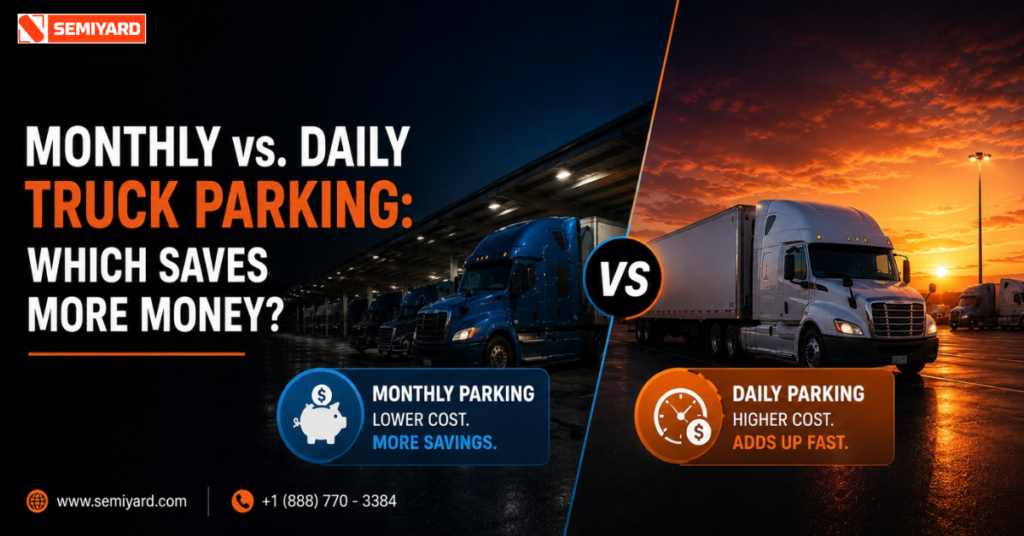
For truck drivers and fleet managers, finding an easily accessible, verified parking spot for their big trucks is a daily headache. With rules governing how long truckers can drive, they have to stop when their time runs out, even if there’s no secure spot available. It makes planning logistics a stressful balancing act. When it comes to paying, choosing between monthly vs daily truck parking is the biggest concern among truckers.
Table of Contents
ToggleKey Takeaways
- Daily truck parking may seem flexible, but costs add up quickly over 20+ days.
- Monthly parking offers a fixed price, allowing you to budget effectively.
- A reserved spot saves time and fuel by eliminating the search for parking.
- Monthly facilities offer better convenience with fences and verified lots, while daily lots may feel riskier.
- Finding daily parking can lead to early stops or wasted fuel, eating into your profits.
- For regional drivers and fleets, monthly parking leads to significant cost savings and reduced stress.
Every decision in commercial transportation affects your trucking business line. To understand your expenses, you need to properly go through the truck parking cost comparison. Many truckers see parking as a cost, paying as they go from state to state. These small costs add up over time and can significantly imbalance your business.
In order to survive the highly competitive trucking market, true cost savings trucking companies need to select the right option by looking closely at the balance between short-term convenience and structured long-term planning.
The State of Trucking Infrastructure
To make a decision, you need to look at the bigger picture of trucking infrastructure. Across the USA, there’s a shortage of parking spaces for trucks and other commercial vehicles. It affects how parking rates develop over time. In areas, parking spaces fill up early, leaving late-night drivers with few options. There is no denying the fact that when parking is scarce, the cost goes up.
Drivers who don’t plan often make dangerous choices. They might park on highway off-ramps, lots, or retail malls. These places can be risky with fines, damage, and cargo theft. To avoid these risks, drivers rely on paid parking. How do you pay for parking? Daily or monthly? Whatever you choose affects your profit at the end of the quarter. Truck parking is an expense.
Daily Truck Parking: The True Cost of Short-Term Flexibility
Daily parking is a bit complex, where truckers pay for a short time, mostly. When analyzing long term vs short-term parking setups, the daily route appeals to those who do not want to be tied down to a single geographic location for just a few minutes.
However, this flexibility comes at a hefty cost. When you purchase parking by the day, you are buying at retail cost. Here’s what actually happens:
- While a single night might seem manageable, multiplying that cost across twenty or twenty-five days of operation reveals a different reality.
- Daily fees build up rapidly, turning what seemed like a convenient choice into an expensive habit. Furthermore, daily spaces are never fixed.
- A driver might plan to stop at a specific location, only to find the lot full upon arrival.
- This forces them to burn valuable fuel and driving hours searching for an alternative, which adds indirect expenses to the business.
- Relying completely on short-term solutions can create unpredictable expenses that disrupt monthly budgets.
For regional operators or those with consistent routes, utilising a structured facility like Semiyard truck parking offers an excellent example of how entering a consistent arrangement removes financial uncertainty while providing a stable, constant parking base for trucks.
Monthly Truck Parking: The Power of Financial Predictability
Monthly parking shifts the strategy from reactive crisis management to proactive operational planning. Under a monthly parking plan, you secure a dedicated, reserved space within a professional facility for a full thirty-day cycle. This approach provides a fixed parking base for independent owner-operators who need a place to park during home time, as well as for regional fleets that require a centralised staging area for their equipment.
When looking for the cheapest truck parking option, looking only at the upfront cost can be misleading. A monthly parking plan requires a larger initial payment compared to a single daily fee, which can cause some cash-conscious operators to hesitate. However, when you break down the total cost on a per-day basis, the monthly framework almost always offers a significant discount. You are essentially buying your space in bulk, which lowers the daily operational cost of that space dramatically. This structure brings valuable predictability to your business, allowing fleet managers to establish fixed overhead costs instead of dealing with fluctuating daily expenses.
Also Read: How Monthly Truck Parking Improves Driver Productivity
A Direct Cost Comparison: Breaking Down the Numbers
Let us look closely at a practical truck parking cost comparison to see how these two systems function over time. Imagine an independent owner-operator who operates regionally and needs a place to park their equipment for roughly twenty days out of the month. The remaining ten days are spent on extended runs or taking time off at home.
- The Daily Approach: If the driver pays the regular retail rate each and every night for twenty days, the total expense increases gradually. And daily rates vary by location and demand, so regional spikes can drive these costs even higher during peak freight seasons. On top of that, a driver has to spend time every day tracking receipts, processing expense reports, and searching for open slots.
- The Monthly Approach: With a monthly plan, the driver pays one flat rate for the entire month. It does not matter if the truck sits in the lot for five days or twenty-five days; the cost remains completely unchanged. When you divide that monthly rate by the twenty days the truck actually used the space, the cost per night is typically a fraction of the standard retail daily rate.
This clear difference shows why long-term arrangements are so effective for stabilising operating budgets. By avoiding individual daily transactions, transportation businesses can achieve significant cost savings that trucking operations require to remain profitable when fuel prices rise or spot market freight rates drop.
Hidden Operations Costs and the Efficiency Gap
When comparing parking options, it’s important to look beyond just the cost of the parking space. There are hidden costs that can hurt a business’s profits. For example, studies show that drivers often stop an hour before they have to, just because they worry they won’t find a parking spot later. This wasted hour means losing potential earnings, driving less during the week, and delaying deliveries.
Another cost is wasted fuel. Driving in busy areas or going from one highway exit to another while searching for a place to park uses fuel but doesn’t help your route. Over a year, this wasted fuel can add up to thousands of dollars in extra costs. Having a monthly parking spot fixes this problem, and so do the parking rates in the USA. With a reserved space, you can use your full driving time without worrying about finding a verified place to park. This cuts down on delays and helps you save money.
Also Read: Overnight Truck Parking Problems Truck Drivers Face Today
Evaluating Strategic Options for Your Fleet
Ultimately, the right choice depends on your specific operational model. However, for regional fleets, dedicated logistics providers, and owner-operators who live near major freight hubs, long-term options offer clear advantages. Utilising an organised network like Semiyard truck parking provides a practical framework for drivers who want to eliminate the stress of the daily search. Choosing a monthly spot with a dedicated provider ensures that your equipment is protected in a professional environment, allowing you to optimise your schedules and maximise your overall efficiency.
Conclusion
When we look closely at the balance between monthly vs daily truck parking, the long-term approach clearly emerges as the most effective strategy for sustainable cost savings that trucking companies can rely on. While daily parking offers flexibility for unpredictable routes, it subjects your business to volatile retail pricing and the constant stress of limited availability. In contrast, monthly parking provides a consistent, convenient framework that lowers your average daily costs, protects your equipment, and allows you to utilise your driving hours fully.
To keep your business competitive, you must control your overhead costs. By shifting away from temporary daily solutions and investing in a structured monthly arrangement, you can eliminate waste and bring stability to your balance sheet. Partnering with a dedicated infrastructure specialist like Semiyard truck parking allows you to secure your assets, streamline your daily operations, and keep your business moving forward smoothly.
FAQs
1. Is monthly truck parking cheaper than daily truck parking?
Yes, for most drivers who park regularly. When you divide the monthly rate by the number of days you actually use it, the cost per month is usually much lower than paying the daily rate every time. Daily parking works like retail pricing, while monthly parking is like buying in bulk.
2. How much money can truck drivers save by switching to monthly parking?
It depends on how often you park, but many drivers see big savings. If you park around 20 days a month, the monthly option often cuts your daily cost in half or more. You also save on hidden costs like extra fuel and lost driving time.
3. What are the hidden costs of daily truck parking?
The highest hidden costs are wasted fuel from driving around looking for spots and lost income from stopping early because you are scared you will not find parking later. These small losses add up to thousands of dollars over a year and hurt your overall profits.
4. Why is it so hard to find truck parking in the USA right now?
There is a real shortage of truck parking spaces across the country. In busy areas, lots fill up early, especially at night. This shortage pushes daily prices higher and forces many drivers into unsafe spots like highway ramps or retail lots.
5. Is monthly truck parking worth it for regional drivers and fleets?
Yes, it is usually the smarter choice. Regional drivers who return to the same areas often get a reserved spot, predictable monthly costs, better security, and the ability to drive their full legal hours without stress. It turns parking from a daily headache into a stable part of your business plan.
6. How does monthly truck parking help with safety and security?
Monthly facilities normally have better protection, like perimeter fencing, gate access, lighting, and video cameras. Daily public lots have high turnover and are more open, which increases the chances of damage, accidents, or cargo theft.
7. Should over-the-road truck drivers still consider monthly parking?
Planning ahead for regular stops along your main lanes can help reduce stress and extra costs. For anyone with consistent regional routes, monthly parking almost always wins on cost and peace of mind.